
Short answer
- A paint roller extension pole screws into the threaded handle of a roller frame so you can roll ceilings and tall walls from the floor, with two hands and even pressure.
- Length: for a standard 8 ft ceiling, a short telescopic pole of about 2–4 ft is usually enough. For 9–10 ft ceilings, look at 4–8 ft. Stairwells, vaulted ceilings and exterior siding need longer poles, which bring more weight and flex.
- Thread: in the US, most threaded roller frames and poles share a 3/4 in., 5 threads-per-inch Acme thread (sizes.com). Tolerances are loose, so check the thread fits your roller frame by hand before you load paint.
- Build: choose a pole that locks firmly at the length you use and stays stiff. Aluminum is light. Fiberglass doesn't conduct electricity the way metal does, which matters outdoors near wires.
A pole is the cheapest way to make painting faster and less tiring. It replaces a lot of ladder moves, keeps the roller at a steady angle and lets your legs and body do the pushing instead of your shoulder. The catch is that a pole that's too long, too floppy or loose at the thread makes the work worse, not better. This guide covers length, thread, locks and materials, then two long-reach picks.
Why use an extension pole for painting
- Ceilings without a ladder. You can roll most of an 8 or 9 ft ceiling standing on the floor. That's safer and much faster than climbing up and down to move a ladder every few feet.
- More even coats on walls. With both hands on a pole, you roll the full height of a wall in one smooth pass, top to bottom. That helps avoid the lap marks and stripes covered in how to fix paint roller marks.
- Less strain. Holding a roller frame by its short handle puts the load on your wrist and shoulder. A pole spreads it across both arms and your body.
- Reach low, too. A short pole saves your back on the bottom third of a wall: you don't have to bend or kneel as much.
Cutting in along the ceiling line and corners still needs a brush or an edger. See the best paint brush for cutting in and how to use a paint edger.
What size extension pole do you need?
Pick the shortest pole that lets you stand flat-footed with your hands between roughly waist and chin height while the roller touches the surface. Every extra foot adds leverage at the far end, which makes the roller harder to steer near corners and the pole more tiring to hold.
| Surface | Typical pole length to look for | Notes |
|---|---|---|
| Walls up to 8 ft | 18 in.–4 ft, or no pole | A short pole helps on the top and bottom thirds |
| 8 ft ceiling | About 2–4 ft | Many adults roll an 8 ft ceiling comfortably with this |
| 9–10 ft ceilings, tall walls | About 4–8 ft | A telescopic 4–8 ft pole covers most homes |
| 12 ft+ ceilings, stairwells, entry halls | 6–12 ft or longer | Expect more weight and flex. Work slower |
| Vaulted ceilings, two-story foyers, exterior siding, eaves | Long telescopic poles (to about 20 ft and beyond) | Heavy when fully extended. Use the shortest setting that reaches |
These ranges are rules of thumb, not fixed sizes. Your height, the roller width and how far you hold the pole from your body all change the answer. If you're between two sizes, a telescopic pole that covers both is the practical choice.
Planning the job too? The paint calculator works out how much paint you need, and the house painting cost calculator estimates what a pro would charge.
Fixed vs telescopic poles
- Fixed-length poles are simple, stiff and have no lock to slip. They're good if you always paint the same rooms.
- Telescopic (adjustable) poles slide out in two or more sections and lock at any length in their range. One pole can do walls, ceilings and a stairwell. The lock is the part to judge (see below).
Extension pole threads: will it fit your roller frame?
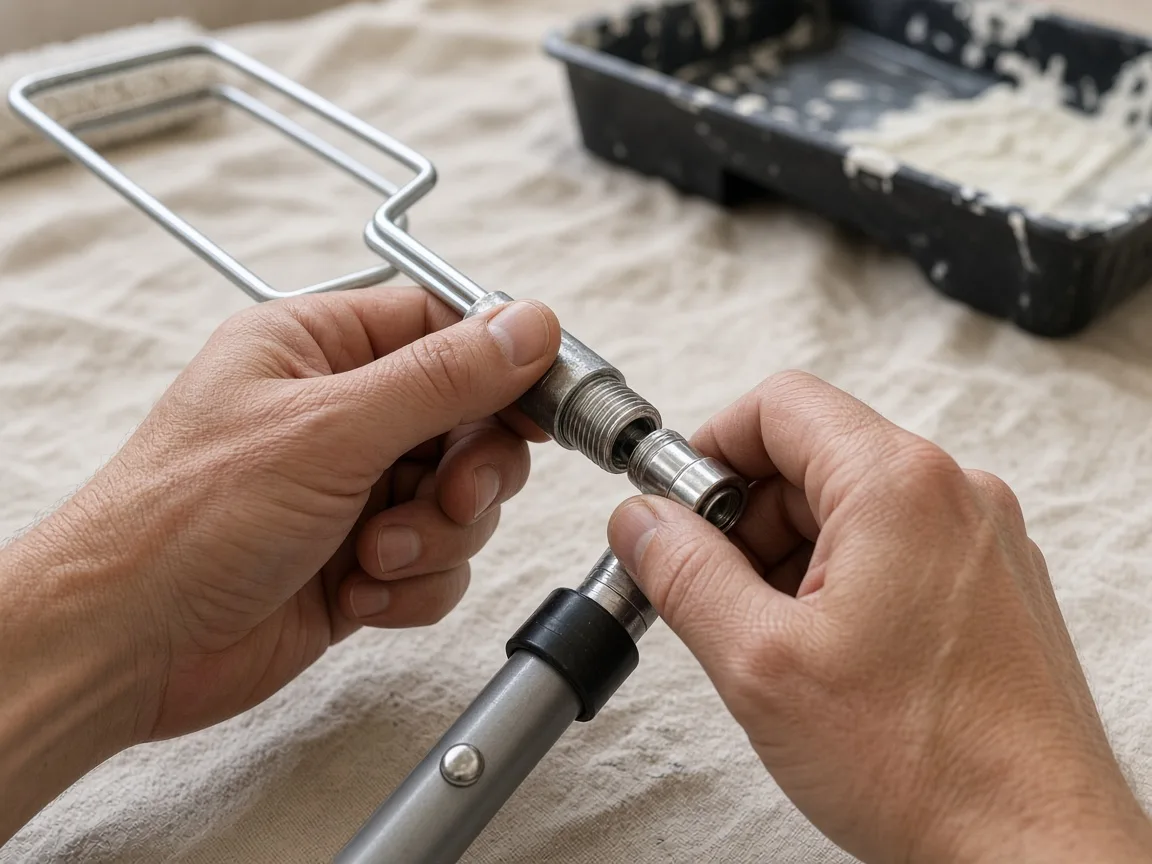
Most US roller frames have a threaded socket in the end of the handle. The common thread for paint roller handles and broom handles is 3/4 in. diameter, 5 threads per inch, Acme form (sizes.com). McMaster-Carr lists its roller frames with a 3/4 in. Acme threaded hole, and Wooster says its Sherlock frames take standard threaded poles. That's why most poles and frames from different brands screw together.
"Most" isn't "all", though:
- Loose tolerances. sizes.com notes the fit is loose. Some pairs wobble even when they're both "standard".
- Metal vs plastic threads. A metal tip screwed into a plastic handle can strip the handle's thread if you overtighten it.
- Quick-lock systems. Some brands use push-button or snap-lock tips that need that maker's frame or an adapter.
- Multi-purpose poles. Poles sold for dusting, cleaning, light bulbs or gutters may use a different tip or a tool adapter. Check the thread fits your roller frame before you rely on it.
The fit test: thread the frame onto the pole by hand until it's snug. Hold the pole and push the roller against a wall, then roll back and forth a few times. If the joint clicks, wobbles or starts to unscrew, don't use that pair overhead. Never tape over a loose thread. To learn more about frames and covers, see our paint roller frame guide.
Locks, materials and grip
Locking mechanism
A telescopic pole is only as good as its lock. It has to hold the length you set while you press upward on a ceiling.
- Twist locks turn one section against the other to clamp it. They're simple, but they can loosen as you roll if the twist direction matches the rolling motion.
- Lever or cam locks clamp with a flip lever. They're quick to adjust and easy to check at a glance.
- Button or pin locks snap into set holes. They can't slip, but you only get the lengths the holes allow.
Whatever the type, set the length, then lean on the pole against the floor before you start. If it shortens, it will shorten on the ceiling too.
Material
| Material | Pros | Cons |
|---|---|---|
| Aluminum | Light, rust-resistant, common on long telescopic poles | Conducts electricity. Can flex when fully extended |
| Fiberglass | Stiff, doesn't conduct electricity the way metal does | Heavier than aluminum at the same length |
| Steel | Stiff and strong at short lengths | Heavy, can rust if paint and water are left on it |
| Wood | Cheap fixed poles, good grip | Fixed length, can warp if stored wet |
Outdoor safety: never use any pole near overhead power lines. Aluminum and steel conduct electricity, and even fiberglass can conduct when wet or dirty. Before you raise a long pole outside, look up and check the whole arc it might swing through.
Grip and weight
A textured grip on the lower section helps when your hands get paint on them. Weight matters more than it seems: a pole that feels light in the store gets heavy after an hour on a ceiling, especially fully extended. If a pole is long enough for your highest job, use it at its shorter settings for everything else.
How to use a paint roller extension pole
- Fit and test the frame. Thread it on by hand and do the wobble test above.
- Set the length. Start shorter than you think. You can always extend it.
- Load the cover evenly. Dip only the lower part of the cover, then roll it on the tray ramp or a bucket grid until it's evenly loaded and no longer dripping. Our paint roller nap guide helps you pick the right cover first.
- Stand under or slightly behind the area. Hold the pole with one hand near the end and the other a shoulder-width up, palms facing each other.
- Roll in sections. Work in an area roughly a few feet wide, roll in a loose W or M, then fill in with straight passes. On ceilings, finish each section with passes in the same direction.
- Keep a wet edge. Overlap the last section while it's still wet to avoid lap marks.
- Watch for drips. Overhead, a loaded roller drips more. Lighter loads and an extra coat usually look better than one heavy coat.
- Clean right away. Remove the cover, wash the frame and wipe the pole tip so paint doesn't dry in the thread. See how to clean a paint roller.
Best paint roller extension poles for high work
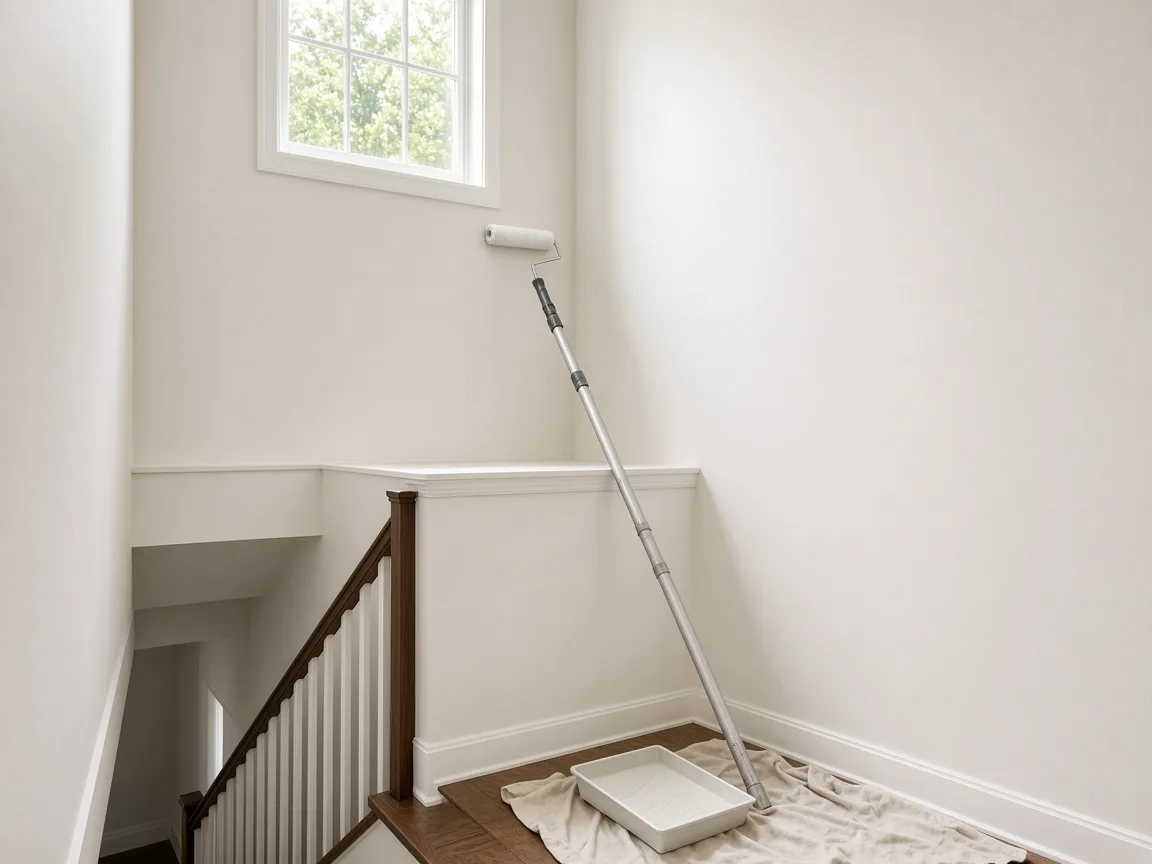
For a standard 8 ft room, almost any sturdy 2–4 ft threaded pole from a paint or hardware store will do, and it's worth buying in person so you can test the lock and thread. The two picks below are for the harder jobs: high ceilings, stairwells, two-story walls and exterior work. Both are multi-purpose telescopic aluminum poles (listed for painting and dusting), so check the thread fits your roller frame before you start.
Longest reach: VEVOR telescopic extension pole, 7–30 ft, aluminum
For vaulted ceilings, two-story foyers, tall exterior walls and other spots you'd otherwise need a tall ladder for. It's highly rated by buyers. A pole this long gets heavy and flexible near full extension, so use the shortest setting that reaches, keep the roller load light, and stay well clear of power lines outdoors. Check the thread fits your roller frame before you load paint.
High ceilings and stairwells: VEVOR telescopic extension pole, 6–24 ft, aluminum
A shorter version for 12 ft+ ceilings, stairwells and entry halls. It starts at a more manageable length, which makes it easier to steer than the 30 ft pole on jobs that don't need the extra reach, and buyers rate it highly too. As with any multi-purpose pole, check the thread fits your roller frame by hand first.
| Pole | Length range | Best for | Before you buy | Shop |
|---|---|---|---|---|
| VEVOR telescopic pole, aluminum | 7–30 ft | Vaulted ceilings, two-story walls, exterior siding | Check the thread fits your roller frame. Mind weight and flex at full length | Check price |
| VEVOR telescopic pole, aluminum | 6–24 ft | 12 ft+ ceilings, stairwells, entry halls | Check the thread fits your roller frame | Check price |
| Any sturdy 2–4 ft or 4–8 ft threaded pole | 2–8 ft | 8–10 ft ceilings and walls | Buy in person, test the lock and the thread | Paint or hardware store |
Common extension pole problems
| Problem | Likely cause | Fix |
|---|---|---|
| The roller wobbles at the joint | Loose thread fit or a worn plastic handle thread | Try another frame, or replace the frame. Don't tape it |
| The pole shortens while you roll | Twist lock not tight, or the lock is worn | Re-lock and test against the floor. Use a lever-lock pole |
| The roller skids instead of rolling | Too much pressure at the far end, or a dragging cage | Lighter pressure, shorter pole, spin-test the frame |
| Drips and spatter overhead | Overloaded cover | Load less and roll off the excess on the grid |
| Stripes on the ceiling | Uneven pressure or a dry edge | Keep a wet edge and finish in one direction |
| Arms and shoulders tire fast | Pole too long or held too far from the body | Shorten the pole and stand under the work |
Caring for an extension pole
- Wipe paint off the tip and thread before it dries. Dried paint in the thread is the main cause of a frame that won't screw on straight.
- Clean the sections. Wet paint on the inner tube can glue a telescopic pole shut. Wipe each section before you collapse it.
- Store it dry and straight, collapsed, hanging or flat. Don't leave it leaning where it can bend.
- Check the lock before each job. Replace a pole whose lock slips or whose tip is cracked.
FAQ
What size extension pole do I need for an 8 ft ceiling?
For most adults, a short pole of about 2–4 ft is enough to roll an 8 ft ceiling from the floor. A telescopic 2–4 ft or 4–8 ft pole also covers taller rooms later.
Do all extension poles fit all paint rollers?
Most US threaded roller frames and poles share the 3/4 in. Acme thread, but quick-lock systems, plastic handles and multi-purpose poles may not fit well. Thread it by hand and rock the joint before painting.
Is a telescopic paint pole better than a fixed pole?
A telescopic pole is more versatile: one pole covers walls, ceilings and stairwells. A fixed pole is stiffer and has no lock to slip. If you only paint standard rooms, either works.
Aluminum or fiberglass extension pole?
Aluminum is lighter and common on long telescopic poles. Fiberglass is stiffer and doesn't conduct electricity the way metal does, which is why it's preferred near electrical hazards. Never use any pole near power lines.
How long of an extension pole do I need for a vaulted ceiling?
It depends on the height of the ceiling's peak. Many vaulted ceilings and two-story foyers need a long telescopic pole in the roughly 12–24 ft range or more. Use the shortest setting that reaches, because long poles get heavy and flex.
Can I use a broom handle as a paint roller extension pole?
Often yes. Many broom handles use the same 3/4 in. Acme thread as roller frames. Check the fit by hand, and make sure the handle is long and stiff enough for the job.