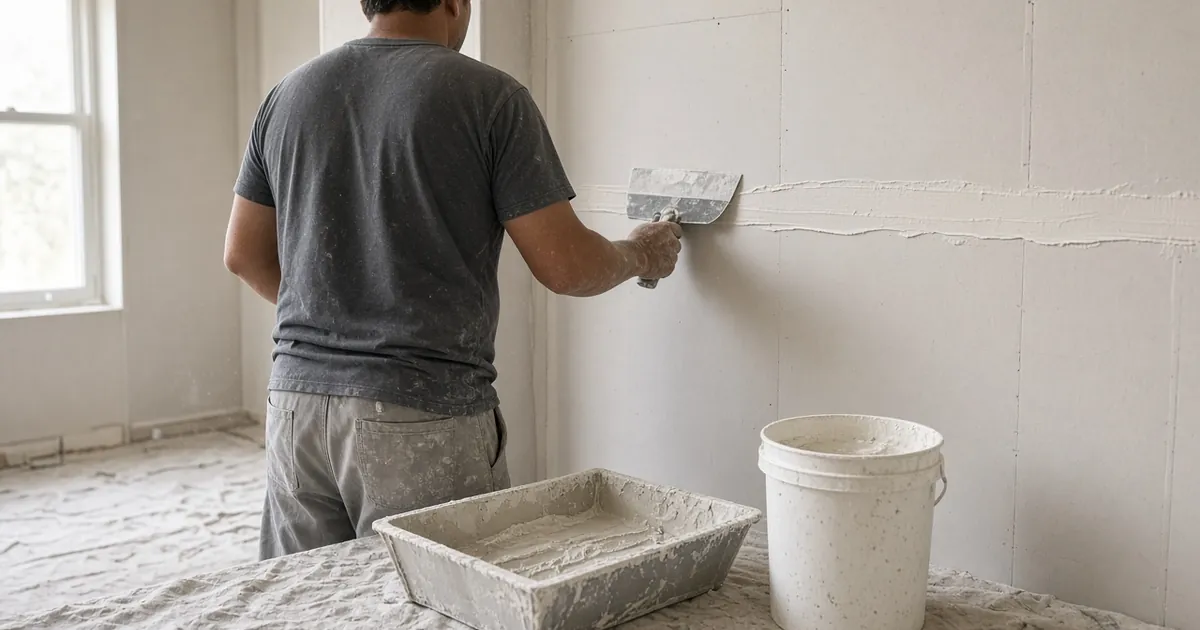
Drywall mud = board area ÷ 1,000 × coverage rate × (1 + waste %), then divide by your container or bag size and round up. Manufacturer data puts ready-mixed joint compound at about 8.2–8.5 gallons per 1,000 sq ft of board for a full finish, and setting-type powder at about 45–55 lb per 1,000 sq ft. A 10 × 12 ft room with 8 ft walls and the ceiling (472 sq ft) needs about 4.4 gallons of ready-mix, or two 18 lb bags of setting-type powder, with 10% extra.
Short version: plan on roughly one 4.5 gallon pail per 16 sheets of 4 × 8 for a standard three-coat finish, and more for a skim coat.
Calculator
Planning estimate only. Coverage defaults come from published manufacturer data for complete finishing; lower levels are pro-rated by coat count. Check the label on the compound you buy.
How to use the drywall mud calculator
| Input | What to enter | Default |
|---|---|---|
| Measure by | Room size, total board area, or number of sheets | Room size |
| Room length, width, wall height | Inside dimensions in feet; tick “Include ceiling” if you’re finishing it | 12 × 10 × 8 ft |
| Board area / sheet count | Use these if you already know the square footage or how many sheets you hung (see the drywall sheets calculator) | 472 sq ft / 15 sheets of 4 × 8 |
| Finish level | How many coats go over the joints (see the table below) | Level 4 |
| Skim thickness | Only used for Level 5 | 1/128 in |
| Ready-mix coverage | Gallons per 1,000 sq ft from your compound’s label | 8.5 gal |
| Container size | Gallons in your pail or carton | 4.5 gal |
| Setting-type coverage / bag size | Pounds per 1,000 sq ft and pounds per bag from the label | 52 lb / 18 lb |
| Waste % | Mud that dries in the pan, falls off the knife or gets sanded away | 10% |
The result shows the board area, ready-mix gallons and containers, the setting-type alternative in bags, and an estimate of joint tape. Ready-mix and powder are alternatives, not a shopping list for both. Many finishers use setting-type for the tape coat or heavy fills and ready-mix for the top coats. In that case, split the numbers by coat (one coat ≈ one third of the full-finish figure).
The drywall mud formula
- Board area = 2 × (length + width) × wall height, plus length × width for the ceiling. Or sheets × sheet area (32, 40 or 48 sq ft).
- Joint-coat mud = area ÷ 1,000 × coverage rate × (coats ÷ 3).
- Skim coat (Level 5 only) = area (sq ft) × 144 × wet thickness (in) ÷ 231, in gallons.
- Total = (joint-coat mud + skim) × (1 + waste %).
- Containers or bags = total ÷ container size, rounded up.
- Joint tape ≈ area × 0.375 ft (about 375 ft per 1,000 sq ft of board).
Published coverage rates describe finishing the whole job, so the calculator treats them as a three-coat (Level 4) finish and pro-rates other levels by coat count. That’s a planning simplification. The tape coat and a wide final coat don’t use exactly the same amount of mud.
How much drywall mud do I need? Worked examples
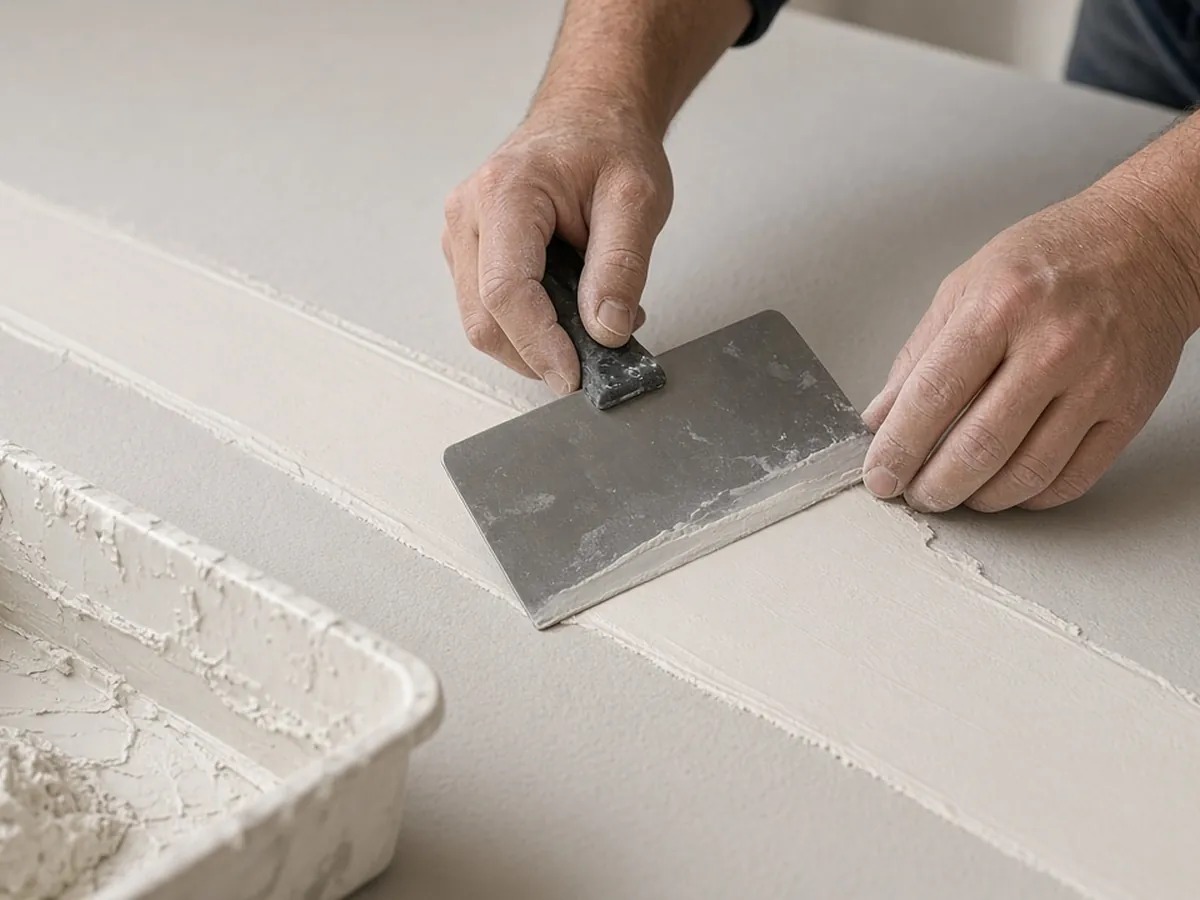
Example 1: 10 × 12 ft room, walls and ceiling, Level 4
- Walls: 2 × (10 + 12) × 8 = 352 sq ft. Ceiling: 10 × 12 = 120 sq ft. Total 472 sq ft.
- Ready-mix: 472 ÷ 1,000 × 8.5 = 4.0 gal × 1.10 = 4.4 gallons → one 4.5 gal pail (with almost no spare), or two 3.5 gal cartons.
- Setting-type: 472 ÷ 1,000 × 52 = 24.5 lb × 1.10 = 27 lb → two 18 lb bags.
- Tape: 472 × 0.375 ≈ 177 ft.
Because 4.4 gallons barely fits in one pail, many DIYers would buy a second container or a small top-up.
Example 2: 20 sheets of 4 × 8, Level 4 vs Level 5
- Area: 20 × 32 = 640 sq ft.
- Level 4: 640 ÷ 1,000 × 8.5 × 1.10 = 6.0 gallons → two 4.5 gal pails.
- Level 5 skim at 1/128 in: 640 × 144 × 0.0078 ÷ 231 = 3.1 gal × 1.10 = 3.4 gal extra. Total 9.4 gallons → three pails.
Example 3: 1,000 sq ft, no waste
- Ready-mix at 8.5 gal/1,000 sq ft: 8.5 gallons → two 4.5 gal pails.
- Setting-type at 52 lb/1,000 sq ft: 52 lb → three 18 lb bags.
Corner bead allowance
Outside corners take extra mud. One manufacturer’s instructions call for at least two coats over the corner bead flanges, with the second coat feathered out about 9 in on each side of the metal nose. Area-based coverage doesn’t count corner bead separately, so for rooms with many outside corners, soffits or window returns, raise the waste allowance (for example to 15–20%). That figure is a planning choice, not a published rate. For bead repairs, see how to repair drywall corner bead.
Joint compound by room size
8 ft walls plus ceiling, openings not subtracted, Level 4, 8.5 gal or 52 lb per 1,000 sq ft, 10% waste, rounded up:
| Room | Board area | Ready-mix (gal) | 4.5 gal pails | Setting-type (lb) | 18 lb bags | Level 5 total (gal, 1/128 in skim) | Joint tape (ft) |
|---|---|---|---|---|---|---|---|
| 10 × 10 ft | 420 sq ft | 3.9 | 1 | 24 | 2 | 6.2 | 158 |
| 10 × 12 ft | 472 sq ft | 4.4 | 1 | 27 | 2 | 6.9 | 177 |
| 12 × 12 ft | 528 sq ft | 4.9 | 2 | 30 | 2 | 7.8 | 198 |
| 12 × 14 ft | 584 sq ft | 5.5 | 2 | 33 | 2 | 8.6 | 219 |
| 14 × 16 ft | 704 sq ft | 6.6 | 2 | 40 | 3 | 10.4 | 264 |
Typical joint compound coverage rates
These are the published approximate coverage figures from manufacturer technical documents. They’re industry reference points, not product recommendations.
| Compound type | Published approximate coverage | Source type |
|---|---|---|
| Ready-mixed, drying type (standard) | About 8.5 gal per 1,000 sq ft | Manufacturer submittal sheet |
| Ready-mixed, lightweight | About 8.2 gal per 1,000 sq ft | Manufacturer construction guide |
| Ready-mixed, all-purpose (heavier) | About 130–140 lb per 1,000 sq ft | Manufacturer construction guide |
| Setting-type powder | About 45–55 lb per 1,000 sq ft (one sheet lists 52 lb) | Manufacturer submittal sheet and guide |
| Paper joint tape | About 350–375 ft per 1,000 sq ft | Manufacturer construction guide |
Both manufacturers note that actual use varies with room layout, application method and the finisher’s skill. Use the rate printed on the compound you buy and enter it in the calculator. Ready-mix packaging commonly includes 4.5 gal pails and 3.5 gal cartons, and setting-type powder comes in bags such as 18 lb. Check the container size, too.
Drywall finish levels and coats
The Gypsum Association’s GA-214 defines six levels of finish. The level sets how many coats you apply, which is why it changes the mud estimate more than anything else.
| Level | What it includes (summarized from GA-214) | Typical use | Calculator coats |
|---|---|---|---|
| 0 | No taping or finishing | Temporary construction | not calculated |
| 1 | Tape embedded in compound at joints and interior angles | Concealed areas such as attics and above ceilings | not calculated |
| 2 | Tape embedded and wiped, one coat over fasteners | Tile substrates, garages, storage areas | 1 |
| 3 | Level 2 plus one additional coat over joints and angles, two coats over fasteners | Medium or heavy texture, heavy wallcoverings | 2 |
| 4 | Two separate coats over flat joints, one over interior angles, three over fasteners and accessories | Flat paint, light texture, wallcoverings | 3 |
| 5 | Level 4 plus a skim coat over the entire surface | Gloss or dark paint, critical lighting | 3 + skim |
What each coat does. The tape coat beds the tape. One manufacturer’s instructions describe a thin layer about 4 in wide with the tape centered and pressed in. The next coat goes about 3 in beyond each side of the tape, and the finish coat is feathered about 3 in beyond that. Each coat is wider and thinner, which is why the later coats still use a fair share of the mud.
Skim coat. GA-214 says there’s no specific mil thickness that makes a proper skim coat. The goal is complete coverage of the surface, with the excess sheared off. That’s why the calculator asks for a wet thickness: 1/128 in over 1,000 sq ft is about 4.9 gallons by volume, 1/64 in about 9.7 gallons, and 1/32 in about 19.5 gallons, before waste.
Setting-type vs premixed (drying-type) mud
| Setting-type powder | Premixed drying-type | |
|---|---|---|
| How it hardens | Chemical set after mixing with water | Dries as the water evaporates |
| Recoat time | Same day once it has set; one guide gives about 2 hours for a quick-setting product | One guide gives about 24 hours for regular compound |
| Strengths | Low shrinkage, heavy fills, little effect from humidity, often used for the tape coat | Ready to use, easier sanding, good for top coats |
| Watch out for | Mix only what you can use within its working time; clean tools before it sets | Protect from freezing; add water only as the label allows |
| How it’s sold | Bags by weight; working time is in the product name or label | Pails and cartons by volume |
Quantities are estimated differently: by weight for powder, by volume for ready-mix. That’s why the calculator gives pounds and bags for one and gallons and containers for the other.
Common mistakes that waste mud
- Piling on thick coats. Thick coats take longer to dry and more sanding. Thin, wider passes use the mud better.
- Over-thinning ready-mix. Extra water makes it runny and can shrink more. Follow the label’s water limits.
- Skipping coats. A Level 2 tape coat under flat paint will usually show the joints. Match the finish level to the paint and lighting.
- Mixing too much setting-type mud. Whatever sets in the pan is wasted. Mix small batches.
- Ordering exactly the estimate. Running out mid-coat leaves visible lap marks. Keep the waste allowance.
- Forgetting repairs. Small fixes need little mud. See how to fix nail pops in drywall.
Drywall mud calculator FAQ
How much drywall mud do I need?
Plan on roughly 8.2–8.5 gallons of ready-mixed compound per 1,000 sq ft of drywall for a full three-coat finish, based on manufacturer coverage figures. Multiply your board area by that rate, add about 10% for waste, and divide by your container size. A 10 × 12 ft room with walls and ceiling (472 sq ft) comes to about 4.4 gallons.
How many buckets of joint compound per sheet of drywall?
At 8.5 gallons per 1,000 sq ft, one 4 × 8 sheet (32 sq ft) takes about 0.27 gallons for a full finish before waste, so one 4.5 gallon pail covers roughly 16 sheets. Ceilings, many corners and heavy-handed coats use more.
How much joint compound for 1,000 square feet?
Published coverage for ready-mixed compound is about 8.2 to 8.5 gallons per 1,000 sq ft, or 130–140 lb for heavier all-purpose mixes. Setting-type powder is listed at about 45–55 lb per 1,000 sq ft. A Level 5 skim coat is extra.
How many 18 lb bags of setting compound do I need?
At about 52 lb per 1,000 sq ft, 1,000 sq ft of board takes about three 18 lb bags. A 472 sq ft room needs about 27 lb with 10% waste, so two bags.
Does finish level change how much mud I need?
Yes. Each GA-214 level adds coats. Level 2 is roughly the tape coat, Level 3 adds one coat, Level 4 adds two, and Level 5 adds a skim coat over the entire surface. The calculator scales the coverage by coat count as a planning estimate.
How much mud does a skim coat take?
GA-214 says there is no specific thickness for a proper skim coat, so the answer depends on how thick you leave it. A wet film of 1/128 in over 1,000 sq ft is about 4.9 gallons by volume; 1/64 in is about 9.7 gallons.
Should I use setting-type or premixed mud?
Setting-type powder hardens by a chemical set, so you can recoat the same day and it shrinks little, which helps for heavy fills and the tape coat. Premixed drying-type compound is ready to use and easier to sand but needs to dry between coats, about 24 hours in one manufacturer’s instructions.
Related calculators and guides
- Drywall sheets calculator: count sheets first, then enter them here
- How to fix nail pops in drywall: secure the panel, then patch
- How to repair drywall corner bead: outside corners and bead repairs
- Paint calculator: primer and paint for the finished walls
- Wallpaper calculator: if the walls get wallcovering instead of paint
- How to fix peeling paint on a bathroom ceiling: ceiling repairs that may need a skim coat
Sources
- USG, ready-mixed drying-type joint compound submittal sheet (J2156): coverage approximately 8.5 gal/1,000 sq ft of gypsum panels; “usage may vary depending on… room design/layout and skill of finisher”; 4.5 gal pail. https://www.usg.com/content/dam/USG_Marketing_Communications/united_states/product_promotional_materials/finished_assets/usg-sheetrock-fast-finish-joint-compound-submittal-en-J2156.pdf
- USG, lightweight setting-type joint compound submittal sheet (J621): approximately 52 lb/1,000 sq ft; 18 lb bags; chemically setting, same-day finishing, low shrinkage, heavy fills. https://www.usg.com/content/dam/USG/pdpmovedocuments/sheetrock-lightweight-settingtype-joint-compounds-easy-sand-submittal-J621.pdf
- National Gypsum, drywall finishing products and construction guide: ready-mix 8.2 gal/1,000 sq ft (lightweight) and 130–140 lb/1,000 sq ft (all-purpose); setting-type 45–55 lb/1,000 sq ft; tape 375 ft/1,000 sq ft (estimating table: 350 ft); 4.5 gal pails and 3.5 gal cartons; coat widths, 24 h / 2 h recoat, corner bead coats. https://www.buildsite.com/pdf/nationalgypsum/National-Gypsum-ProForm-Brand-Drywall-Finishing-Products-and-Construction-Guide-Product-Catalog-B23953.pdf
- Gypsum Association, GA-214-2021 Levels of Finish for Gypsum Panel Products: Levels 0–5, skim coat definition. https://www.americangypsum.com/sites/default/files/2022-05/ga-214-2021_17.pdf