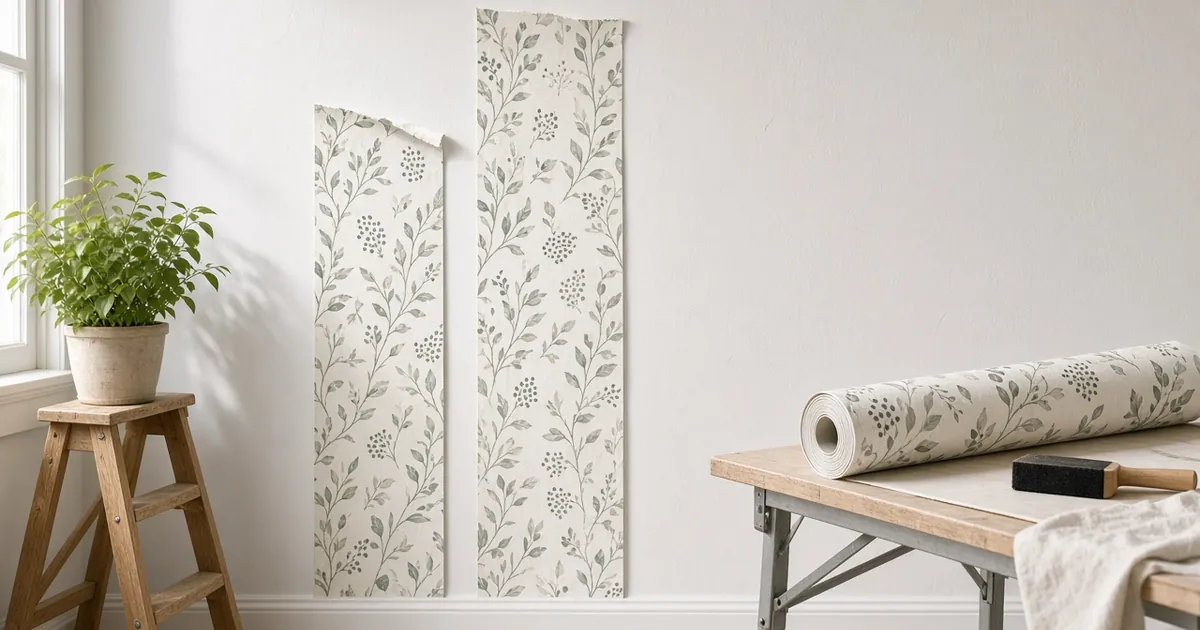
To calculate wallpaper rolls, count strips, not square feet:
- Strips needed = wall width (inches) ÷ roll width, rounded up.
- Cut length = wall height + 4 in for trimming, rounded up to a whole pattern repeat.
- Strips per roll = roll length ÷ cut length, rounded down.
- Rolls = strips needed ÷ strips per roll, rounded up.
For a typical 12 × 14 ft room with 8 ft walls and one door, that's 29 strips → 10 double rolls of 20.5 in × 33 ft wallpaper. A large pattern repeat can push it much higher (worked example below).
Calculator
Planning estimate only. Check product labels, local prices and code before you buy.
The strip method, step by step
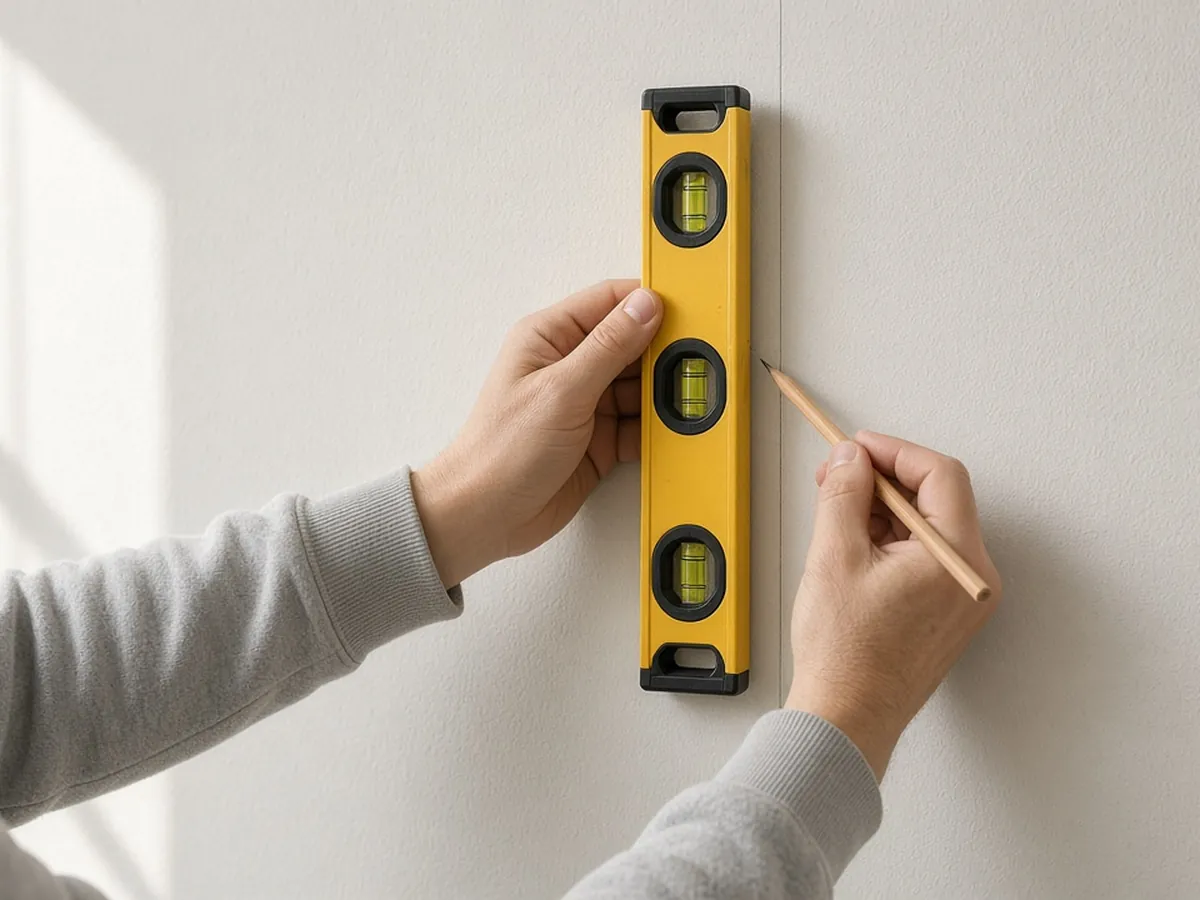
- Measure each wall's width in inches and add them up (the room's perimeter). Subtract full-height openings such as doors and closet openings. Don't subtract windows unless they're very large, because you'll still need strips above and below them.
- Strips needed = total width ÷ roll width, rounded up.
- Cut length = wall height + 4 inches (about 2 in at the top and 2 in at the bottom for trimming, per York Wallcoverings' guidance).
- Pattern repeat: for straight-match or drop-match papers, round the cut length up to a whole number of repeats so each strip starts at the same point in the pattern. Random-match papers (textures, stripes) don't need this.
- Strips per roll = roll length (in inches) ÷ cut length, rounded down. Leftover pieces usually aren't full height.
- Rolls = strips needed ÷ strips per roll, rounded up. Add one roll for mistakes and future repairs if the paper is expensive or hard to reorder.
Check the roll label for width, length, repeat and match type. A common double roll is 20.5 in × 33 ft (about 56 sq ft), while a single roll is about half that. Other widths exist.
How many rolls of wallpaper do I need? Room-size chart
8 ft walls, 20.5 in × 33 ft double rolls, one 36 in door subtracted, windows not subtracted, little or no repeat (3 strips per roll):
| Room | Perimeter | Strips | Double rolls |
|---|---|---|---|
| 10 × 10 ft | 40 ft | 22 | 8 |
| 10 × 12 ft | 44 ft | 24 | 8 |
| 12 × 12 ft | 48 ft | 27 | 9 |
| 12 × 14 ft | 52 ft | 29 | 10 |
| 14 × 16 ft | 60 ft | 34 | 12 |
With 33 ft rolls, you get 3 full strips per roll as long as the cut length is 132 in (11 ft) or less. Once a tall wall or a big repeat pushes the cut length over 132 in, you only get 2 strips, and the roll count jumps.
Worked example: why pattern repeat matters
12 × 14 ft room, 9 ft (108 in) walls, one door → 52 ft perimeter = 624 in − 36 in = 588 in ÷ 20.5 = 29 strips.
| Pattern repeat | Cut length (108 + 4, rounded to repeat) | Strips per 33 ft roll | Double rolls |
|---|---|---|---|
| None / random match | 112 in | 3 | 10 |
| 12 in | 120 in | 3 | 10 |
| 21 in | 126 in | 3 | 10 |
| 27 in | 135 in | 2 | 15 |
The same room needs 50% more paper with a 27 in repeat. Always check the repeat before you order.
Accent wall example
One 12 ft wide × 8 ft high wall: 144 in ÷ 20.5 = 8 strips. Cut length is 100 in, so 3 strips per 33 ft roll, which means 3 double rolls.
Why not just divide square feet?
The square-foot shortcut (wall area ÷ usable sq ft per roll, often quoted as about 25 sq ft per single roll with no repeat, ~22 with a small repeat and ~18 with a large one) is a quick sanity check. It ignores how many full-height strips you can cut from each roll. For the 12 × 14 ft room with 8 ft walls in the chart, the square-foot shortcut gives about 8 double rolls, but the strip method shows you need 10. Use the strip method to order.
Ordering tips
- Buy all rolls from the same batch (dye lot) number. Colors can vary between batches, per York's guidance.
- Order an extra roll for repairs, especially for discontinued-risk or custom papers.
- Peel-and-stick panels are often sold in different widths and lengths. Redo step 2 with their exact size.
- Removing old paper first? See how to remove wallpaper from a wall. For walls you'll paint instead, use the paint calculator.
Wallpaper calculator FAQ
How many rolls of wallpaper do I need for a 12 × 12 room?
About 9 double rolls (20.5 in × 33 ft) for 8 ft walls with one door and little or no pattern repeat: 27 strips at 3 strips per roll. Larger repeats or taller walls can need more.
How do you calculate wallpaper with pattern repeat?
Add 4 inches of trim to the wall height, then round up to the next whole multiple of the repeat. That's your cut length. Divide the roll length by it, rounded down, to get strips per roll.
How much wallpaper do I need for an accent wall?
Divide the wall width in inches by the roll width to get strips (a 12 ft wall takes 8 strips of 20.5 in paper). Then divide by strips per roll. For 8 ft walls and 33 ft rolls, that's 3 double rolls.
What is the difference between a single roll and a double roll of wallpaper?
A double roll is twice the length of a single roll, packaged as one. A common double roll is 20.5 in × 33 ft (about 56 sq ft). Double rolls usually waste less because you get more full-length strips per roll.
Should I subtract windows and doors?
Subtract doors and other full-height openings. Usually don't subtract windows, since you still need strips above and below them, and the offcuts rarely match.
How much extra wallpaper should I buy?
The strip method already includes trim. Many installers add one extra roll for mistakes and future repairs. Buy it from the same batch number.
Related guides
- How to remove wallpaper from a wall
- Paint calculator
- Drywall sheets calculator: if walls need repair first
- How to fix nail pops in drywall
- Laser measure vs tape measure
Sources
- York Wallcoverings, Wallpaper Calculator and installation guidance (trim allowance per strip, pattern repeat and match types, batch numbers). https://www.yorkwallcoverings.com/wallpaper-calculator · https://yorkwallcoverings.com/pages/installation-guide