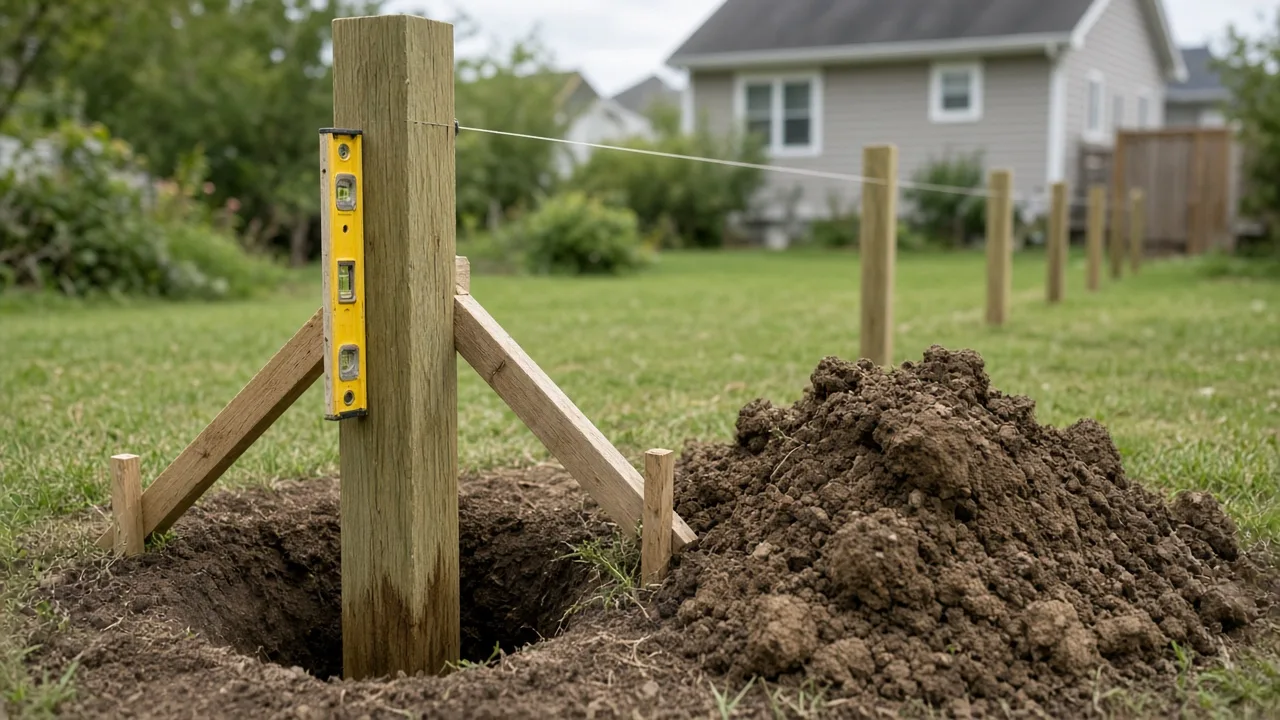
Set fence posts so about one-third of the post's total length is in the ground, and in cold climates go below your local frost line, whichever is deeper. For a typical 6 ft privacy fence that means an 8 ft post with roughly 30–32 in buried, in a hole about 6 in deeper for gravel. Make the hole about three times the post's width: 10–12 in across for a 4×4.
That is the common rule of thumb from concrete makers and fence builders, not a building code. Your soil, wind exposure, gate weight and local rules can push the number deeper. For a 4×4 in a 10 in hole with about 2 ft of concrete, plan on two 80 lb bags or three 50 lb bags of fast-setting mix per post. The full table is below.
The short rules
| Rule | What it means in practice |
|---|---|
| 1/3 of post length in the ground | 8 ft post → about 32 in buried; 10 ft post → about 40 in |
| Below the frost line where the ground freezes | If your frost depth is deeper than the 1/3 figure, the frost depth wins |
| Add about 6 in for gravel | Dig the hole that much deeper and fill the bottom with gravel for drainage |
| Hole width ≈ 3 × post width | 4×4 (3.5 in actual) → 10–12 in hole; 6×6 (5.5 in actual) → 16 in or so |
| Corner, end and gate posts go deeper and wider | They carry the pull of the whole run or the swing of a gate |
Some builders, and Quikrete's own post calculator, use a slightly deeper version: bury half of the above-ground height (3 ft in the ground for a post that stands 6 ft tall). Both are planning rules. If you are between two depths, go deeper. Digging an extra 4 in now is far cheaper than resetting a leaning post later.
Fence post depth by fence height
The table uses the one-third rule and adds 6 in of gravel at the bottom. It assumes firm soil and no frost line deeper than the "buried" figure. Post lengths are common stock sizes; choose the next size up if you need more in the ground.
| Fence height above ground | Typical post length | Post buried (about 1/3) | Total hole depth with 6 in gravel | Hole width for a 4×4 |
|---|---|---|---|---|
| 3 ft (picket, garden) | 5 ft | about 20–24 in | about 26–30 in | 10 in |
| 4 ft | 6 ft | about 24 in | about 30 in | 10 in |
| 5 ft | 8 ft | about 32–36 in | about 38–42 in | 10–12 in |
| 6 ft (privacy) | 8 ft | about 24–32 in* | about 30–38 in | 10–12 in |
| 8 ft | 12 ft | about 36–48 in | about 42–54 in | 12 in |
*An 8 ft post on a 6 ft fence leaves only 24 in in the ground. Many builders accept that in mild climates and good soil. If you want the full one-third (32 in) or you get strong wind, buy 9 or 10 ft posts and cut the tops after the concrete cures.
How deep should a 6 ft fence post be? Plan on at least 2 ft, and closer to 3 ft if you can: 30–32 in is a common target. Go deeper still if your frost line is deeper, the fence is solid board in an open, windy spot, or the post holds a gate.
Frost line: when the rule of thumb is not enough
Where winters freeze, wet soil expands as it freezes and can lift a shallow post a little every year. This is called frost heave. It shows up as posts that rise, lean or push their concrete collars out of the ground.
- Find your frost depth from your local building department. It is set locally, not nationally, and can vary between neighboring counties.
- Get the bottom of the post (and its concrete) below that depth. If the frost depth is 36 in and the one-third rule says 30 in, dig to 36 in plus gravel.
- Shape the hole so it is not wider at the top. A hole that flares out near the surface gives freezing soil something to grab. Straight sides or a slightly wider bottom are better.
- In warm climates with little or no frost, the one-third rule and your soil usually decide the depth.
Also check whether your town requires a fence permit, has height limits or setback rules, and what your HOA allows. Those rules can affect post spacing and height, and sometimes depth.
How big should the fence post hole be?
The hole should be about three times the width of the post. That gives a collar of concrete or packed gravel thick enough to resist side load.
| Post | Actual size | Typical hole diameter |
|---|---|---|
| 4×4 wood | 3.5 × 3.5 in | 10–12 in |
| 6×6 wood (gate, corner, heavy fence) | 5.5 × 5.5 in | 16 in |
| Round steel line post (chain link) | about 1-5/8 to 2-3/8 in | 8–10 in, per the fence maker's instructions |
| Vinyl post sleeve | varies by system | follow the manufacturer's spec |
A wider hole is not automatically stronger. Mostly, it uses more concrete. Depth and a solid, undisturbed hole wall do most of the work.
Concrete, gravel or tamped soil?
| Method | Good for | Watch out for |
|---|---|---|
| Concrete collar | Most wood privacy fences, gate posts, windy sites, loose soil | Shape the top so water runs away from the post. Don't pour a concrete "plug" under the post, or water will pool at the end grain |
| Compacted gravel | Well-drained soil, line posts on lighter fences, easier future replacement | Needs careful tamping in thin layers; less resistance than concrete in soft soil |
| Tamped native soil | Light garden fences, temporary runs | Lowest strength; posts can loosen over time |
Many builders use concrete on corner, end and gate posts and gravel or concrete on line posts. Whatever you choose, keep the 6 in gravel base under wood posts so water can drain away from the end grain. To work out how much gravel to order for the bases (or for gravel-set posts), use the gravel calculator.
How many bags of concrete per fence post?
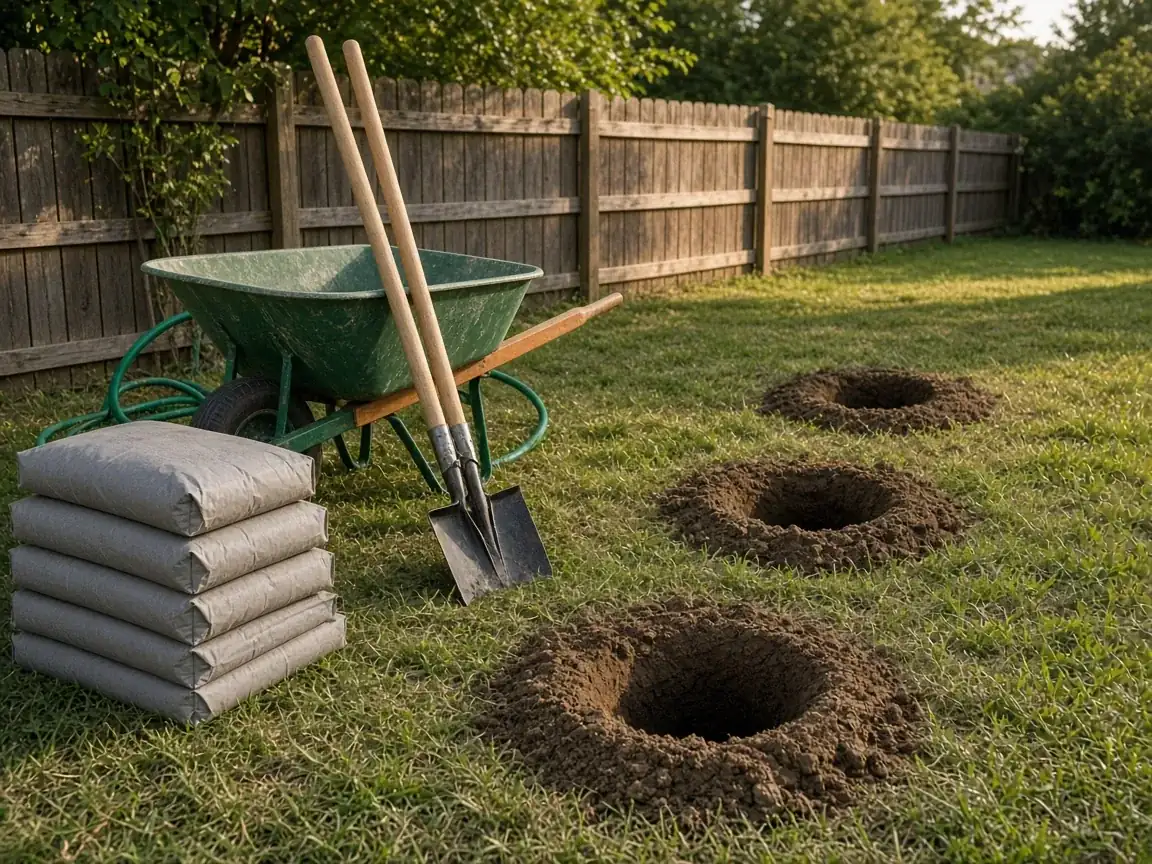
For a 4×4 post in a 10 in hole with about 24 in of concrete: two 80 lb bags, three 60 lb bags, or three 50 lb bags of fast-setting mix. A deeper or wider hole needs more, as the table shows.
The math is simple: concrete = hole volume − post volume. Then divide by the bag's yield.
- Hole volume (cu ft) = 3.1416 × (hole diameter in inches ÷ 2)² × concrete depth in inches ÷ 1,728
- Post volume (cu ft) = post width × post depth (actual inches) × concrete depth ÷ 1,728
- Bags = (hole − post) ÷ bag yield, rounded up
Use the concrete depth, not the hole depth: leave out the 6 in of gravel at the bottom, and any soil you plan to put on top.
Bag yields printed by Quikrete: 80 lb ≈ 0.60 cu ft, 60 lb ≈ 0.45 cu ft, and 50 lb Fast-Setting ≈ 0.375 cu ft. Other brands are similar, but check the yield printed on the bag you are buying.
Bags of concrete per fence post (by hole size)
| Post | Hole diameter | Concrete depth | Concrete per post | 80 lb bags | 60 lb bags | 50 lb fast-setting |
|---|---|---|---|---|---|---|
| 4×4 | 10 in | 24 in | 0.92 cu ft | 1.5 → 2 | 2.0 → 2–3 | 2.5 → 3 |
| 4×4 | 10 in | 30 in | 1.15 cu ft | 1.9 → 2 | 2.6 → 3 | 3.1 → 3–4 |
| 4×4 | 10 in | 36 in | 1.38 cu ft | 2.3 → 3 | 3.1 → 3–4 | 3.7 → 4 |
| 4×4 | 12 in | 30 in | 1.75 cu ft | 2.9 → 3 | 3.9 → 4 | 4.7 → 5 |
| 4×4 | 12 in | 36 in | 2.10 cu ft | 3.5 → 4 | 4.7 → 5 | 5.6 → 6 |
| 6×6 | 16 in | 36 in | 3.56 cu ft | 5.9 → 6 | 7.9 → 8 | 9.5 → 10 |
| 6×6 | 16 in | 42 in | 4.15 cu ft | 6.9 → 7 | 9.2 → 10 | 11.1 → 11–12 |
| 2-3/8 in round steel | 10 in | 30 in | 1.29 cu ft | 2.1 → 2–3 | 2.9 → 3 | 3.4 → 4 |
Calculated with actual post sizes (a 4×4 is 3.5 in square, a 6×6 is 5.5 in square) and the bag yields above. Where the result sits just over a whole number (for example 2.05), you will often finish with the lower count if the hole is a little narrow or you stop the concrete slightly below grade. Keep one spare bag on site rather than running short mid-pour.
Why bag labels say fewer. Quikrete's fast-setting data sheet says two 50 lb bags set a 3 in post in a 9 in hole 30 in deep. That works because the hole is narrower and the fill stops a few inches below the surface. Buy for the hole you actually dig.
Bags for a whole fence
- Count posts. With posts 8 ft apart, posts = run length ÷ 8, rounded up, + 1. A 100 ft straight run is 14 posts. Add extra posts for corners and both sides of each gate.
- Multiply posts × bags per post from the table. Do gate and corner posts separately at their larger hole size.
- Add a small allowance (one or two bags) for an oversized hole or a spill.
To see what the whole job costs, including posts, panels, gates and labor, run the same run length and post count through the fence cost calculator.
Example: 100 ft run, 13 line posts (4×4, 10 × 30 in) + 1 end post, 2 gate posts (6×6, 16 × 36 in) → 14 × 2 + 2 × 6 = 40 bags of 80 lb mix, plus a spare.
Want the volume for an odd-sized hole? Use the round-column option in the concrete calculator and subtract the post.
How to set a fence post at the right depth
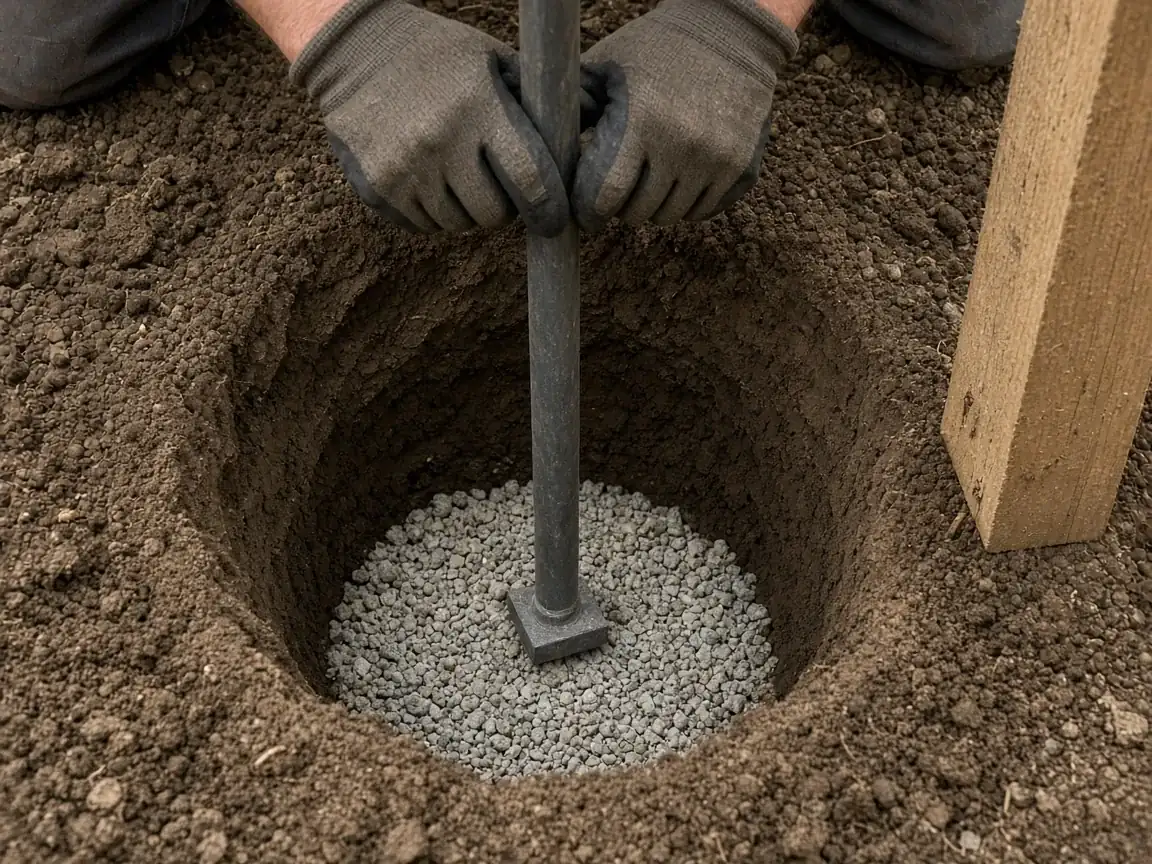
- Call 811 before you dig. It is the free US call-before-you-dig line that has buried utility lines marked. Confirm your property line and any permit, too.
- Mark the line with string between the end posts and mark each post location.
- Dig to depth plus 6 in. A manual post-hole digger works for a few holes; a rented power auger saves a lot of time on long runs in clear soil. Keep the walls straight and undisturbed.
- Add about 6 in of gravel and tamp it firm.
- Set the post on the gravel, brace it on two sides and check plumb on two adjacent faces with a level.
- Fill with concrete. Follow the bag's instructions: some fast-setting mixes are poured dry and then soaked with water, while standard mixes are mixed first. Stop a little below grade if you want to cover the collar with soil, or crown the top so water sheds away from the post.
- Let it cure before you hang rails or panels. Fast-setting mixes set quickly, but the bag will say how long before you load the post; standard mixes need longer.
Common mistakes
- Burying too little of the post to save on lumber. A 6 ft fence on an 8 ft post with only 18–20 in buried is a common cause of leaning fences.
- Ignoring the frost line in cold regions.
- A bell-shaped hole that's wider at the top, which gives frost and wind more to push on.
- No drainage under wood posts, so water sits against the end grain.
- Concrete flush with or below soil in a cup shape, which collects water around the post.
- Treating gate posts like line posts. A swinging gate puts much more load on its post.
FAQ
How deep should fence posts be?
About one-third of the post's total length, plus roughly 6 in for a gravel base. In areas where the ground freezes, the post must go below the local frost line if that is deeper. A 6 ft fence on an 8 ft post typically has 24–32 in buried.
How deep should a 6 ft fence post be?
At least 2 ft in the ground, and around 30–32 in is a common target. Buy 9–10 ft posts if you want the full one-third buried or your site is windy, and go to the frost depth if your area requires it.
How many bags of concrete per fence post?
For a 4×4 post in a 10 in hole with about 2 ft of concrete, plan on two 80 lb bags or three 50 lb bags of fast-setting mix. A 12 in hole 3 ft deep takes about four 80 lb bags. A 6×6 gate post in a 16 in hole can take six or more.
How many 50 lb bags of concrete for a 4×4 post?
About 2.5 bags for a 10 × 24 in fill and about 3 bags for a 10 × 30 in fill, so buy 3 to 4 per post. Quikrete's example of two bags assumes a narrower 9 in hole with the concrete stopped below grade.
How wide should a fence post hole be?
About three times the post's width: 10–12 in for a 4×4 and about 16 in for a 6×6. Follow the manufacturer's spec for vinyl and chain-link systems.
Do fence posts need to be below the frost line?
In cold climates, yes, if you want to avoid frost heave lifting the posts. Your local building department can tell you the frost depth used in your area.
Should I put gravel at the bottom of a fence post hole?
Yes, for wood posts. About 6 in of compacted gravel lets water drain away from the end grain and gives the post a firm base to sit on.
Sources
- Quikrete, Setting Posts project sheet: hole diameter about three times the post width, depth one-third of the post length plus 6 in for gravel, below the frost line for structural posts.
- Quikrete Fast-Setting Concrete Mix data sheet (1004-50): 50 lb bag ≈ 0.375 cu ft; two bags for a 3 in post in a 9 × 30 in hole.
- Quikrete Concrete Mix data sheet (1101): 80 lb ≈ 0.60 cu ft, 60 lb ≈ 0.45 cu ft.
- Sakrete, How to Set Posts & Poles: hole about 3× post width, 4–6 in gravel base, frost line.