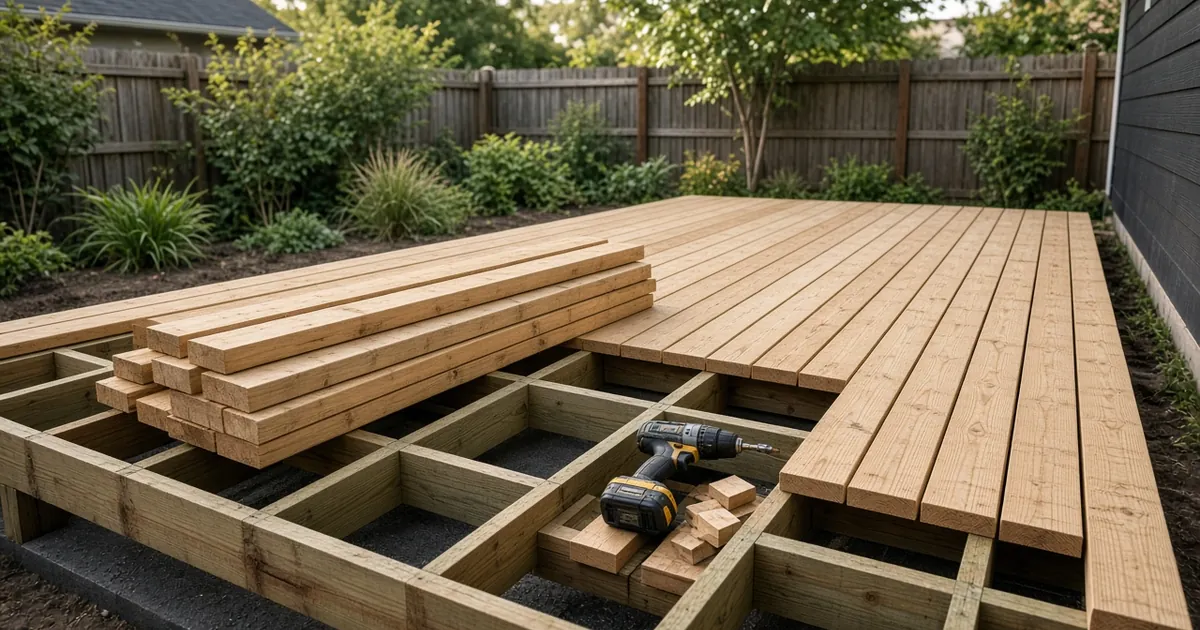
Deck boards = rows × deck length ÷ board length, plus 5–10% for waste, rounded up. Rows = the deck width across the boards (inches) ÷ (board width + gap). With standard 5.5 in wide boards and a 1/8 in gap, each row takes 5.625 in. A 12 × 16 ft deck with boards running the 16 ft way needs 26 rows → 26 boards of 16 ft, or 29 boards with 10% extra.
Short version: one square foot of deck uses about 2.13 linear feet of 5.5 in boards with a 1/8 in gap.
Calculator
Planning estimate only. Check product labels, local prices and code before you buy.
How to use the deck board calculator
Enter either the deck length × width (more accurate) or the total deck area, then:
| Input | What to enter | Typical value |
|---|---|---|
| Deck length (along the boards) | The direction the boards run, in feet | Often parallel to the house |
| Deck width (across the boards) | The direction you lay rows, in feet | Often the joist direction |
| Board width | The actual width, not the nominal size | 5.5 in for 5/4×6, 2×6 and most composite boards |
| Board length | The length you'll buy | 8, 10, 12, 14, 16 or 20 ft |
| Gap | The space between boards | About 1/8 in (follow the product instructions) |
| Waste % | Allowance for cuts, defects and trimming | 5–10% straight; 15% or more diagonal |
| Cost per board (optional) | Your store's price for that length | Gives a total decking cost |
The calculator returns rows, linear feet, the number of boards to buy and an optional cost. It covers the deck surface only. Stair treads, fascia, picture-frame borders and railings are separate line items.
The deck board formula
- Rows = deck width across the boards (in) ÷ (actual board width + gap), rounded up. The last row may need ripping to width.
- Linear feet = rows × deck length along the boards (ft).
- Boards = linear feet × (1 + waste %) ÷ board length, rounded up.
- Cost = boards × price per board.
Area shortcut (when you only know square feet): boards = area (sq ft) × 12 ÷ (board width + gap) ÷ board length × (1 + waste %).
The shortcut is fine for a first estimate. The row method is better for ordering, because it shows how each row actually gets built from whole boards.
How many deck boards do I need? Worked examples
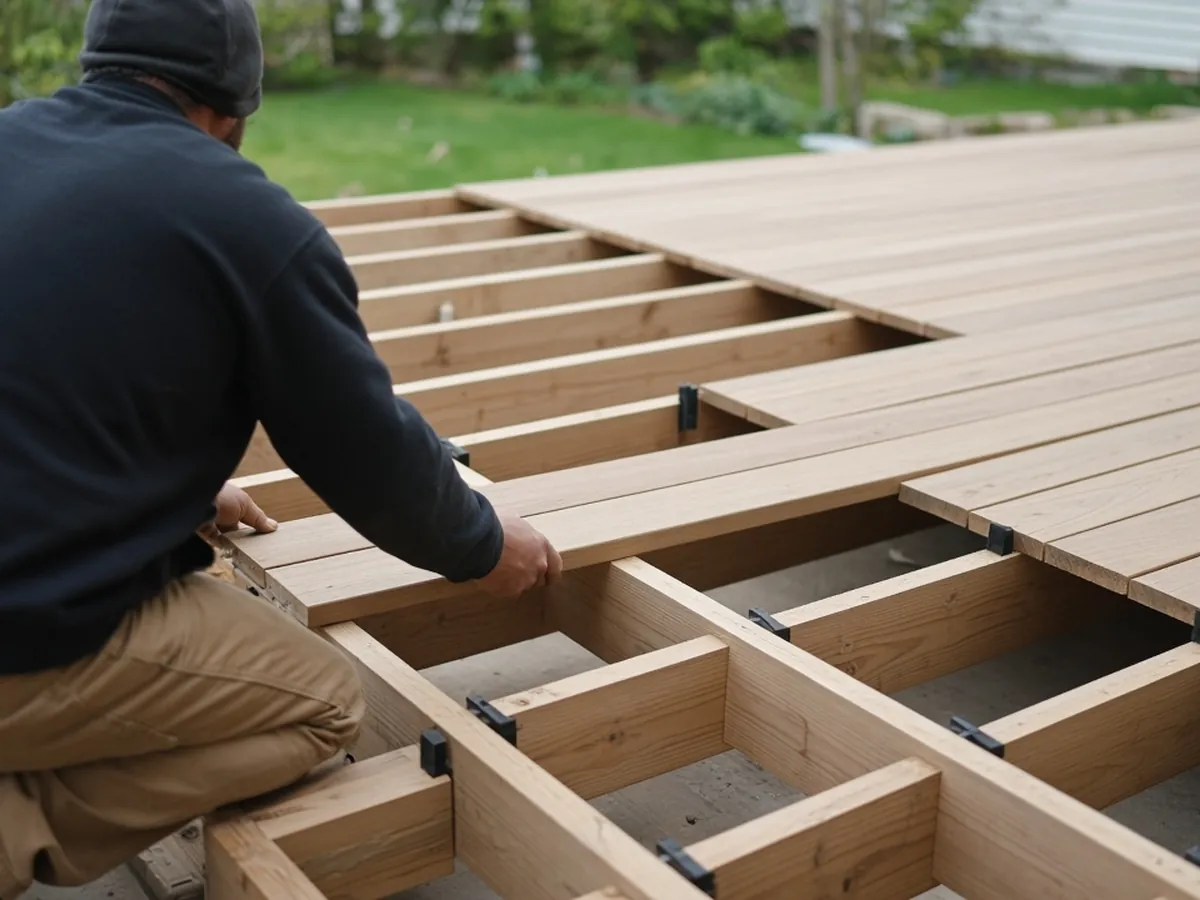
Example 1: 12 × 16 ft deck, 16 ft boards
- Boards run the 16 ft direction, so rows go across 12 ft = 144 in.
- Rows = 144 ÷ (5.5 + 0.125) = 25.6 → 26 rows
- Linear feet = 26 × 16 = 416 ft
- Boards = 416 × 1.10 ÷ 16 = 28.6 → 29 boards of 16 ft
Each row is one full-length board, so there are no butt joints. A board exactly as long as the deck leaves no trim allowance. If you plan to overhang the rim or trim the ends flush after installing, buy the next length up or keep the waste allowance.
Example 2: 10 × 20 ft deck, 12 ft vs 20 ft boards
- Rows across 10 ft = 120 ÷ 5.625 = 21.3 → 22 rows
- Linear feet = 22 × 20 = 440 ft
| Board length | Linear-foot estimate (+10%) | Row-by-row check | Butt joints |
|---|---|---|---|
| 20 ft | 22 × 1.10 = 24.2 → 25 boards | 1 board per row = 22, plus spares | None |
| 10 ft | 440 × 1.10 ÷ 10 = 48.4 → 49 boards | 2 per row = 44, plus spares | 1 per row |
| 12 ft | 440 × 1.10 ÷ 12 = 40.3 → 41 boards | Up to 2 per row = 44 if you can't reuse the 4 ft offcuts | 1–2 per row |
The lesson: pick a board length that divides evenly into the deck length (or matches it). With 12 ft boards on a 20 ft run, every row needs a 12 ft piece plus an 8 ft piece, leaving a 4 ft offcut. Unless you plan to use those offcuts elsewhere, order closer to the row-by-row number. Butt joints also need to land on a joist (or doubled joist or blocking), and DCA 6 asks for each decking piece to bear on at least three supports, so short offcuts may not be usable. The joint layout depends on your framing.
Example 3: area only, 200 sq ft
200 × 2.133 = 426.7 linear ft. With 10% waste, that's 40 boards of 12 ft, 30 of 16 ft or 24 of 20 ft.
Example 4: adding cost
For the 12 × 16 ft deck at an example price of $25 per 16 ft board (an illustration, not a market quote): 29 × $25 = $725 for the decking surface. Plug in your local price per board. If your store prices by the linear foot, multiply linear feet with waste (416 × 1.10 = 457.6 ft) by that rate instead.
Deck board sizes: nominal vs actual
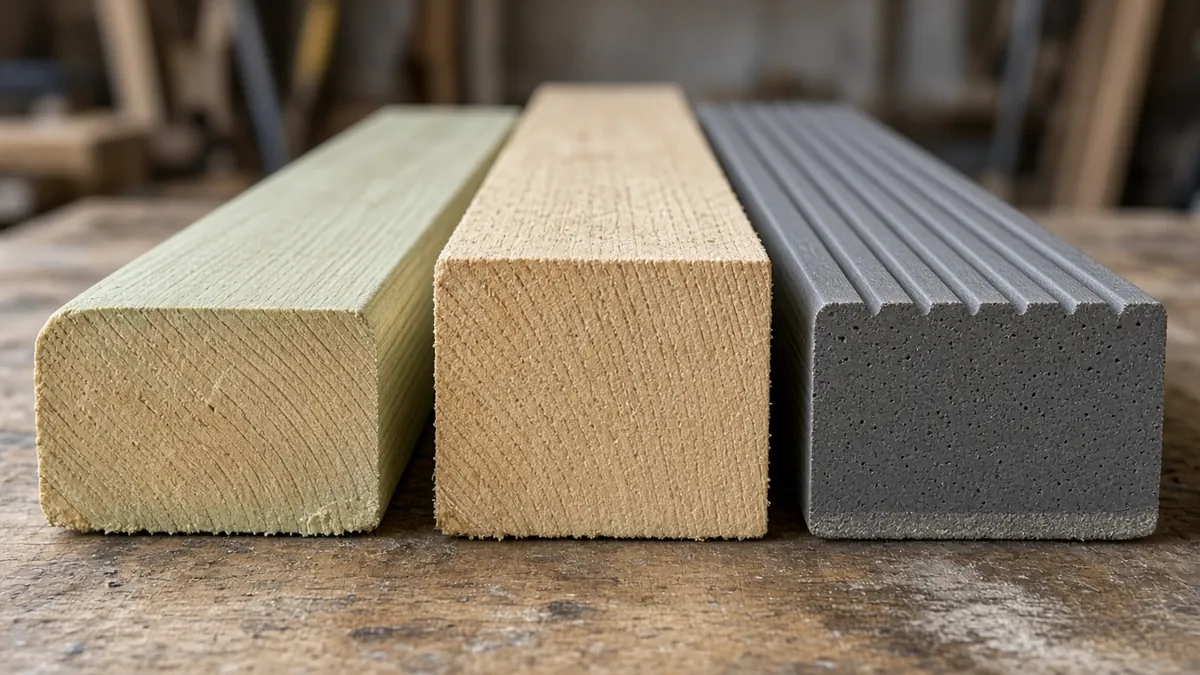
Lumber is sold by nominal size, but the calculator needs the actual width.
| Board (nominal) | Actual size (typical) | Width + 1/8 in gap | Sq ft covered per 12 / 16 / 20 ft board | Linear ft per sq ft |
|---|---|---|---|---|
| 5/4 × 6 (radius-edge decking) | about 1 × 5.5 in | 5.625 in | 5.6 / 7.5 / 9.4 | 2.13 |
| 2 × 6 | 1.5 × 5.5 in | 5.625 in | 5.6 / 7.5 / 9.4 | 2.13 |
| 2 × 4 | 1.5 × 3.5 in | 3.625 in | 3.6 / 4.8 / 6.0 | 3.31 |
| Composite or PVC decking | often close to 5.5 in wide; thickness varies | check the spec sheet | depends on the product | depends on the product |
- Coverage per board = (actual width + gap) ÷ 12 × board length.
- A wider gap changes the count a little. At 1/4 in, a 5.5 in board covers 5.75 in, or about 2.09 linear ft per sq ft.
- Thickness doesn't change the count, but it changes the framing. Under the IRC decking table, as summarized in the American Wood Council's DCA 6 guide, 5/4 (1-1/4 in nominal) wood decking allows joists up to 16 in on center perpendicular and 12 in diagonal. Nominal 2 in decking allows 24 in perpendicular and 16 in diagonal. Composite decking follows the manufacturer's span rating. Check your local code.
How many deck boards for common deck sizes
5.5 in boards, 1/8 in gap, boards running the longer side, one board length per row (board length = deck length), 10% waste, rounded up:
| Deck size | Area | Rows | Board length | Boards to buy (+10%) |
|---|---|---|---|---|
| 8 × 8 ft | 64 sq ft | 18 | 8 ft | 20 |
| 10 × 10 ft | 100 sq ft | 22 | 10 ft | 25 |
| 10 × 12 ft | 120 sq ft | 22 | 12 ft | 25 |
| 12 × 12 ft | 144 sq ft | 26 | 12 ft | 29 |
| 12 × 16 ft | 192 sq ft | 26 | 16 ft | 29 |
| 14 × 20 ft | 280 sq ft | 30 | 20 ft | 33 |
| 16 × 16 ft | 256 sq ft | 35 | 16 ft | 39 |
| 16 × 20 ft | 320 sq ft | 35 | 20 ft | 39 |
| 20 × 20 ft | 400 sq ft | 43 | 20 ft | 48 |
For a simple rectangle with full-length boards, 5% is often enough (the 12 × 16 deck would need 28 boards). Use 10% if you're new to decking, picking through lumber-yard boards, or cutting around posts.
Waste factor, gaps and layout
- Straight layout: 5–10% is a common allowance.
- Diagonal layout: plan on 15% or more, because every row starts and ends with an angled cut. Diagonal decking also needs the tighter joist spacing above.
- Picture-frame border or breaker board: count the border boards separately (perimeter ÷ board length), then run the field boards inside it.
- Gap: DCA 6 calls for spacing wood decking boards approximately 1/8 in apart. Composite and PVC makers publish their own side and end gaps, which can depend on temperature at install. Follow the product's instructions.
- Board direction: boards are usually laid perpendicular to the joists. On a deck attached to a house, the joists typically run away from the house, so the boards run parallel to it. DCA 6 allows decking from perpendicular up to 45° to the joists.
Screws and fasteners for deck boards
DCA 6 calls for two fasteners per board at every joist (2-8d threaded nails or 2-#8 screws). To estimate face screws:
Screws = rows × joists each row crosses × 2
For the 12 × 16 ft deck with joists 16 in on center under the 16 ft boards: 16 × 12 ÷ 16 + 1 = 13 joists. 26 rows × 13 × 2 = 676 screws, plus extras for the rim and mistakes. Boxes are sold by count or by weight, so check the label. Hidden-fastener systems follow the manufacturer's clips-per-board instructions.
Deck board calculator FAQ
How many deck boards do I need for a 12 × 16 deck?
With 5.5 in boards, a 1/8 in gap and 16 ft boards running the long way: 26 rows, so 26 boards, or 29 with 10% waste. With 12 ft boards on the 16 ft run, you'd need more boards and butt joints over joists.
How do I calculate deck boards per square foot?
Divide 12 by the actual board width plus the gap. For 5.5 in boards with a 1/8 in gap, that's 12 ÷ 5.625 = 2.13 linear feet per square foot. Multiply by the deck area, add waste, and divide by the board length.
How many deck boards do I need for 100 square feet?
About 213 linear feet of 5.5 in boards with a 1/8 in gap. With 10% waste, that's 20 boards of 12 ft, 15 of 16 ft or 12 of 20 ft.
What is the actual size of a 5/4x6 deck board?
About 1 in thick and 5.5 in wide. A 2×6 is 1.5 × 5.5 in, and a 2×4 is 1.5 × 3.5 in. Composite boards vary, so check the spec sheet.
How much should I space deck boards?
The AWC's DCA 6 guide specifies about 1/8 in between wood deck boards. Composite and PVC boards follow the manufacturer's gap chart, which may change with the temperature at install.
How much waste should I add for deck boards?
About 5–10% for a straight layout and 15% or more for diagonal decking. Use the higher end if you're cutting around posts or can't reuse offcuts.
How do I estimate decking cost?
Multiply the number of boards by the price per board, or linear feet with waste by the price per linear foot. Add fasteners, fascia, stair treads and railings separately.
Related calculators and guides
- Fence cost calculator: price the fence or privacy screen around your deck
- Concrete calculator: footings and post holes
- Gravel calculator: a gravel bed under a low deck
- Paint calculator: the same area × coats ÷ coverage math works for deck stain (use the coverage on the can)
- Vinyl plank flooring cost calculator: indoor flooring, priced per square foot
- Laser measure vs tape measure: measure the deck before you order
Sources
- American Wood Council, DCA 6: Prescriptive Residential Wood Deck Construction Guide (2015 IRC edition): decking spacing of about 1/8 in, two fasteners per joist, minimum three supports per decking segment, perpendicular-to-45° placement. https://awc.org/wp-content/uploads/2022/02/AWC-DCA62015-DeckGuide-1804.pdf
- International Residential Code decking joist-spacing table (1-1/4 in: 16 in perpendicular / 12 in diagonal; 2 in: 24 in / 16 in), as reproduced in municipal deck guidance based on DCA 6. Section numbers vary by code edition.