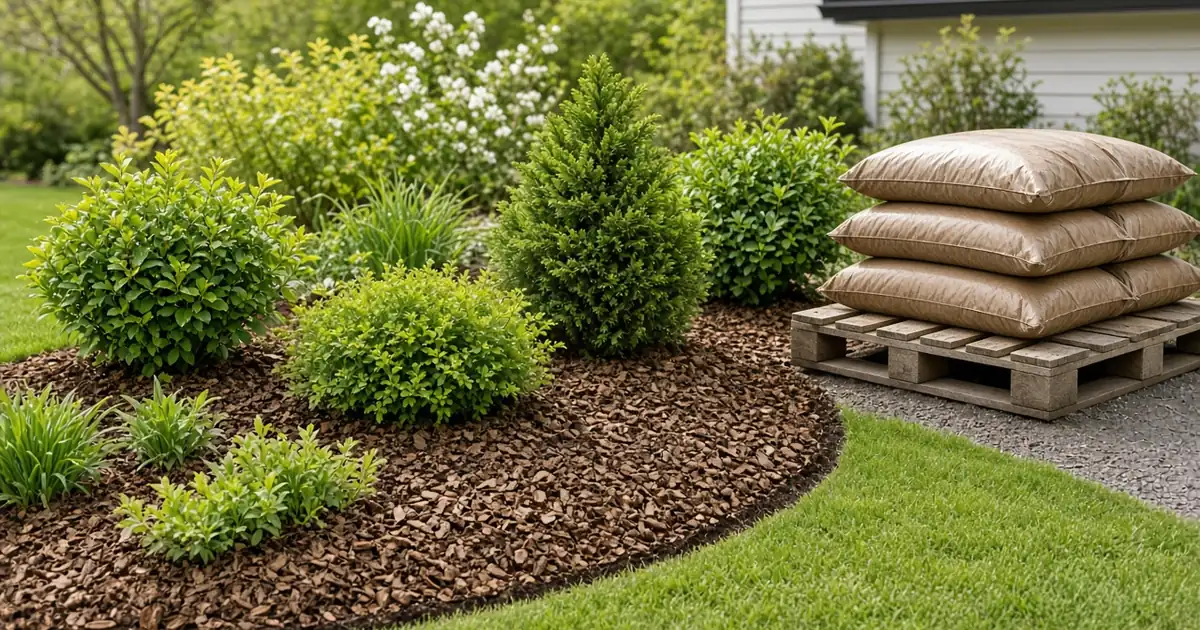
Bags of mulch = bed area (sq ft) × depth (inches) ÷ 12 ÷ bag size (cu ft). For a 100 sq ft bed at 3 inches deep, that's 25 cubic feet: 13 bags of 2 cu ft or 9 bags of 3 cu ft. Enter your bed size and depth in the calculator above for cubic yards and bag counts with a settling allowance.
How many bags is a yard of mulch? One cubic yard is 27 cubic feet, so it equals 13.5 bags of 2 cu ft (buy 14), 9 bags of 3 cu ft, or 18 bags of 1.5 cu ft.
How many bags is a yard of mulch?
| Bag size (printed on the bag) | Bags per cubic yard | Buy |
|---|---|---|
| 1 cu ft | 27 | 27 |
| 1.5 cu ft | 18 | 18 |
| 2 cu ft (most common bagged mulch) | 13.5 | 14 |
| 3 cu ft | 9 | 9 |
Bags per yard = 27 ÷ bag size. Bagged mulch is sold by volume, so check the cubic feet on the bag rather than the weight. Some bags are sold in liters or quarts outside the usual sizes. One cubic foot is about 28.3 liters.
Yards to bags for bigger orders (2 cu ft bags): 2 yards = 27 bags · 3 yards = 41 bags · 5 yards = 68 bags. At that point, compare the price per cubic foot: bag price ÷ cubic feet per bag vs bulk price per yard ÷ 27. Delivery fees and how far you'd carry bags often decide it.
How to calculate how much mulch you need
- Measure the bed in feet. For rectangles, area = length × width. For circles, area = 3.14 × radius². Split odd shapes into rectangles and circles and add them up.
- Choose a depth (see the next section). Most beds use 2–4 inches.
- Cubic feet = area × depth in inches ÷ 12.
- Cubic yards = cubic feet ÷ 27. This is the same formula Texas A&M AgriLife Extension gives for compost, soil and mulch.
- Bags = cubic feet ÷ bag size, rounded up. Add about 10% for settling and uneven ground.
Worked example: a 30 × 8 ft bed at 3 inches deep is 240 sq ft × 3 ÷ 12 = 60 cu ft (2.2 yd³). With 10% extra, that's 66 cu ft (2.4 yd³) = 33 bags of 2 cu ft or 22 bags of 3 cu ft.
How many bags of mulch do I need? Quick table
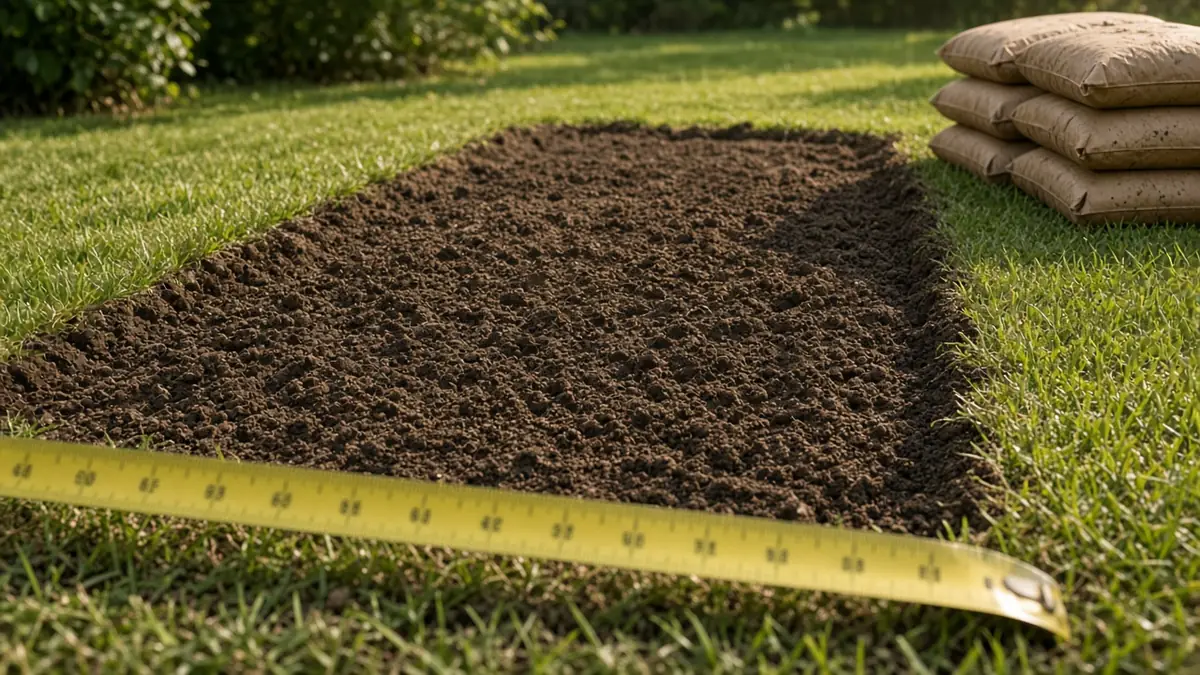
2 cu ft bags, rounded up, before the 10% allowance:
| Bed area | 2 in deep | 3 in deep | 4 in deep |
|---|---|---|---|
| 50 sq ft | 5 bags | 7 bags | 9 bags |
| 100 sq ft | 9 bags | 13 bags | 17 bags |
| 200 sq ft | 17 bags | 25 bags | 34 bags |
| 300 sq ft | 25 bags | 38 bags | 50 bags |
| 500 sq ft | 42 bags | 63 bags | 84 bags |
3 cu ft bags: 100 sq ft needs 6 / 9 / 12 bags at 2 / 3 / 4 inches. 500 sq ft needs 28 / 42 / 56 bags.
How far does a yard go? One cubic yard covers about 162 sq ft at 2 in, 108 sq ft at 3 in and 81 sq ft at 4 in.
How deep should mulch be?
Depth is the number you control, and it changes the order the most:
| Mulch type | Typical depth | Why |
|---|---|---|
| Shredded hardwood or bark | 2–4 in (Iowa State University Extension) | Enough to suppress weeds without smothering roots |
| Fine or double-shredded mulch | 1–2 in (Colorado State University Extension) | Fine material packs down and can shed water if too deep |
| Topping up an existing bed | Only enough to restore the target depth | Measure what's left before ordering |
- Keep mulch off trunks and stems. University of Maryland Extension warns against piling mulch against tree trunks ("volcano mulching"), which holds moisture against the bark. Leave a gap of a few inches.
- Measure existing mulch first. If 1–2 inches remain from last year, you may need only a 1-inch refresh.
Bagged vs bulk mulch
| Bagged | Bulk (by the yard) | |
|---|---|---|
| Best for | Small beds, top-ups, tight access | Large beds, new landscapes |
| Ordering math | Cu ft ÷ bag size | Cu ft ÷ 27 = yards |
| Handling | Easy to carry and store | Needs a tarp/driveway spot and a wheelbarrow |
| Cost check | Bag price ÷ cu ft | Yard price ÷ 27, plus delivery |
How the calculator works
The calculator converts each bed's area and depth to cubic feet, adds a settling allowance, and reports cubic yards and bag counts for common bag sizes. Assumptions are listed on our methodology page and inputs on data sources. Bag sizes vary by brand, so check the label before you buy.
Mulch calculator FAQ
How many bags is a yard of mulch?
One cubic yard is 27 cubic feet: 13.5 bags of 2 cu ft (buy 14), 9 bags of 3 cu ft, or 18 bags of 1.5 cu ft.
How many bags of mulch do I need for 100 square feet?
At 3 inches deep, 100 sq ft needs 25 cubic feet: 13 bags of 2 cu ft or 9 bags of 3 cu ft. At 2 inches it's 9 bags of 2 cu ft, and at 4 inches it's 17.
How many square feet does a 2 cu ft bag of mulch cover?
About 12 sq ft at 2 inches deep, 8 sq ft at 3 inches, and 6 sq ft at 4 inches.
How many bags of mulch are in a pallet?
It varies by retailer and bag size, so check the store listing. To compare, convert the pallet to cubic feet (bags × bag size) and divide by 27 for yards.
Is it cheaper to buy mulch in bags or bulk?
Compare per cubic foot: bag price ÷ bag size vs bulk price per yard ÷ 27, plus delivery. Bulk often wins for big beds, while bags suit small jobs and tight access.
How deep should mulch be?
Typically 2–4 inches for shredded hardwood or bark, and 1–2 inches for fine or double-shredded mulch. Keep it pulled back from trunks and stems.
Related calculators and guides
- Gravel calculator: same yards math for stone
- Best landscape edging for gravel
- How to install landscape edging: keeps mulch in the bed
- Concrete calculator
Sources
- Texas A&M AgriLife Extension, Travis County, How much compost, soil or mulch? (L × W × depth ÷ 12 ÷ 27). https://travis-tx.tamu.edu/about-2/horticulture/soils-and-composting-for-austin/how-much-compost-soil-or-mulch/
- Iowa State University Extension and Outreach, mulching guidance (2–4 in for shredded hardwood). https://yardandgarden.extension.iastate.edu/
- Colorado State University Extension, mulch guidance (1–2 in for fine mulch). https://extension.colostate.edu/
- University of Maryland Extension, mulching trees and shrubs (keep mulch off trunks). https://extension.umd.edu/resource/mulching-trees-and-shrubs/