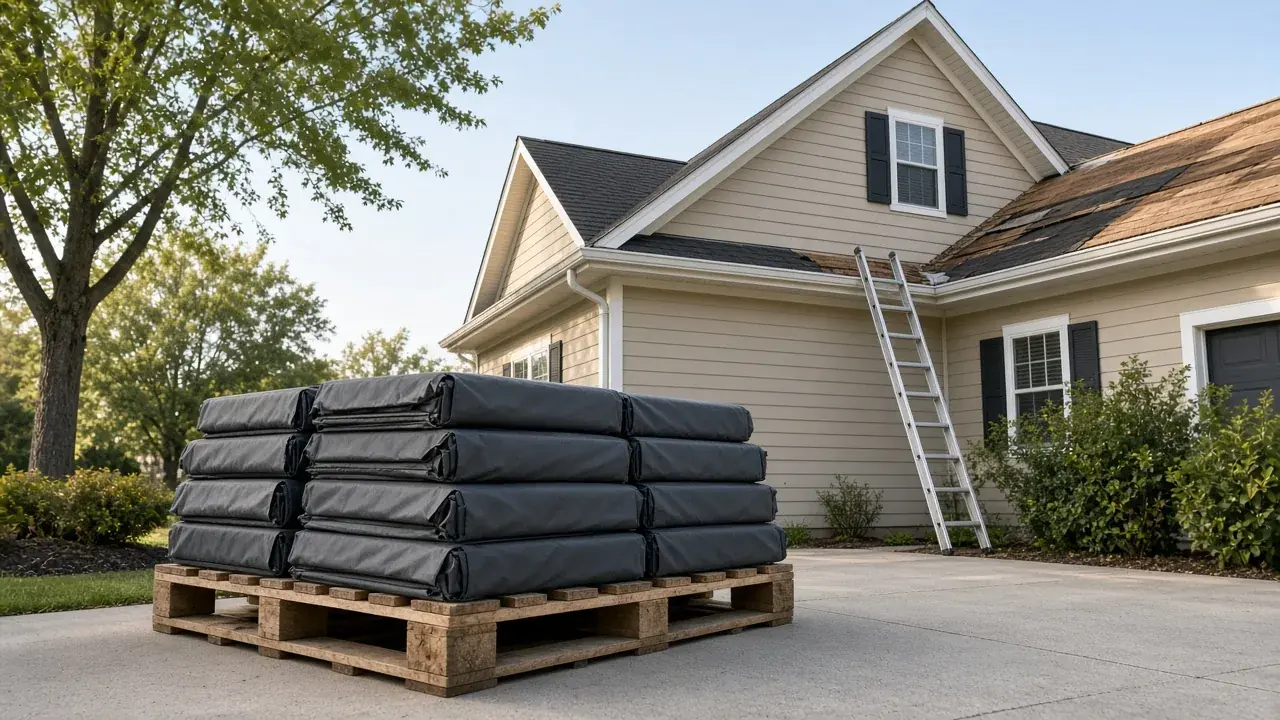
Bundles = roof squares × 3, plus 10–15% for waste, rounded up. A roofing square is 100 sq ft of roof surface, and most 3-tab and architectural shingles take three bundles per square, so one bundle covers about 33⅓ sq ft. A 2,000 sq ft roof is 20 squares: 60 bundles before waste, or 66 bundles with 10% waste.
Two things trip people up. First, use the roof's sloped surface area, not the house's floor area. Second, starter strip and ridge cap are usually separate products, counted by length. Some heavy designer shingles also come four or five bundles to the square, so check the wrapper of the product you are buying.
Shingle bundle coverage
| Shingle type | Bundles per square (usual) | Coverage per bundle | Notes |
|---|---|---|---|
| 3-tab | 3 | about 33.3 sq ft | The classic flat-look shingle |
| Architectural (dimensional, laminated) | 3 | about 33.3 sq ft | Most common on new US re-roofs; heavier per bundle than 3-tab |
| Designer / luxury (slate or shake look) | 4 or 5 | about 20–25 sq ft | Thicker and heavier, so they're packed in more, smaller bundles |
| Starter strip | n/a | sold by linear feet | Runs along eaves and often rakes |
| Hip and ridge cap | n/a | sold by linear feet | Coverage varies a lot by product |
Always read the wrapper. It prints the coverage per bundle or bundles per square for that exact product. That beats any rule of thumb, including this one.
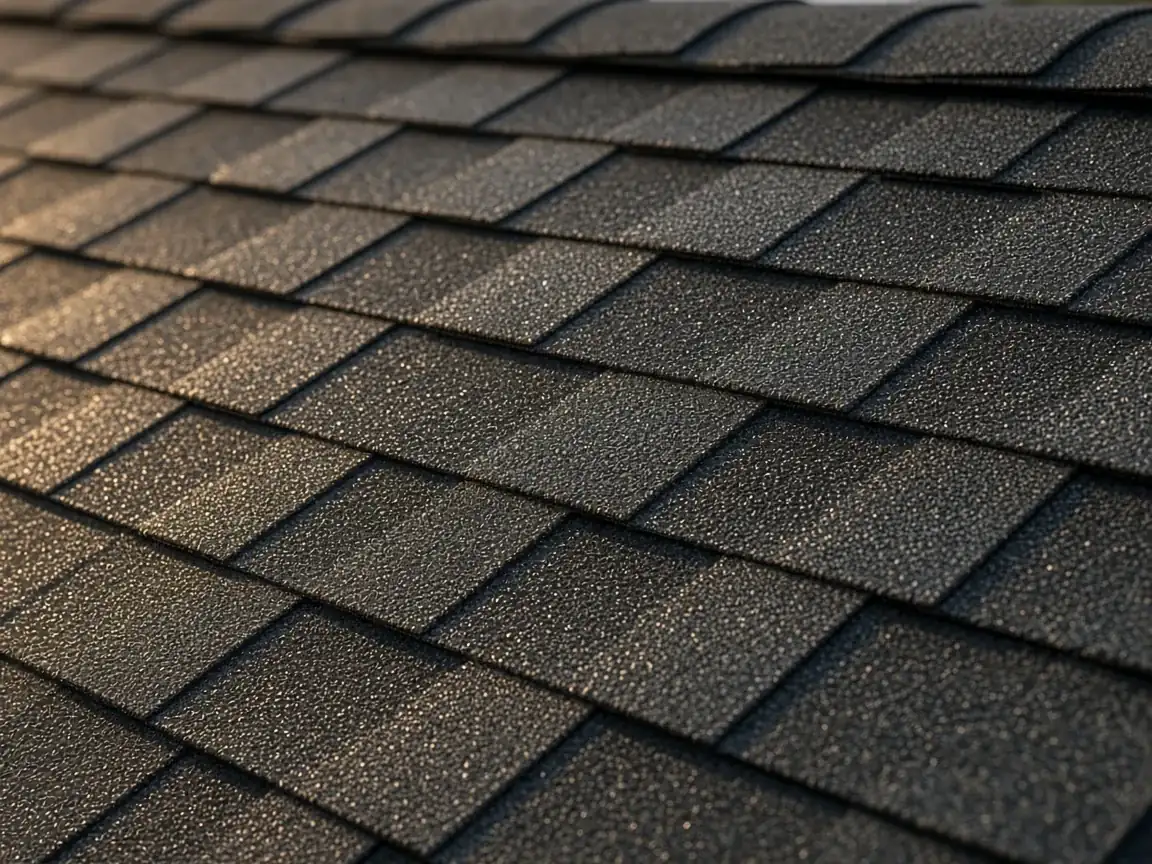
How to calculate how many bundles of shingles you need
Step 1: Get the roof area
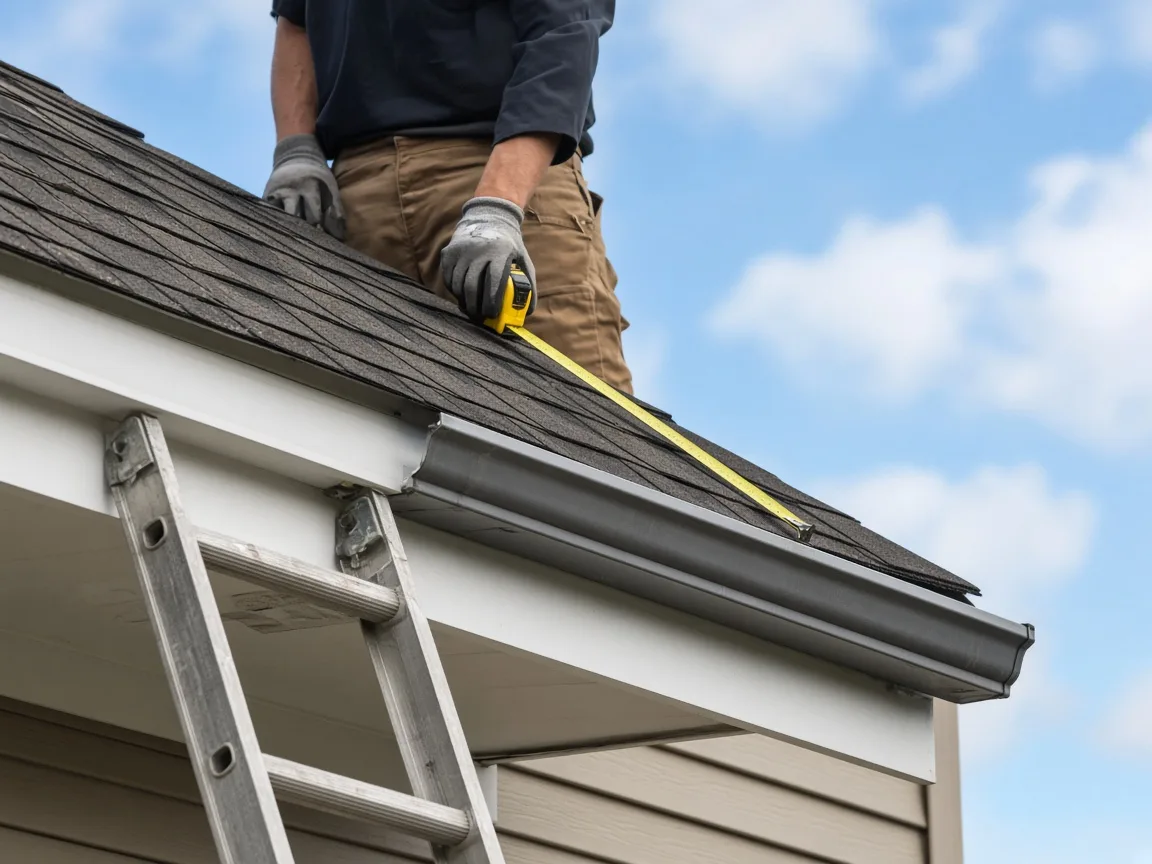
The most accurate number comes from measuring each roof plane (length × width) and adding them up, or from a roof measurement report. If you'd rather not climb on the roof, which is the safer choice, estimate from the ground:
- Measure the house footprint including overhangs. A long tape or a laser measure both work from the ground. Measure the walls, then add the eave and rake overhang on each side. Example: 40 × 28 ft walls with 1 ft overhangs → 42 × 30 ft = 1,260 sq ft.
- Multiply by the pitch factor from the table below to convert that flat area into sloped roof surface.
Add separate areas for porches, garage roofs and dormers.
Step 2: Adjust for roof pitch
Pitch is the rise in inches per 12 inches of horizontal run. A 6/12 roof rises 6 in for every 12 in. You can usually read it from the attic: hold a level horizontally against a rafter, measure 12 in along the level, and measure straight up to the underside of the rafter. Or use an angle-finder app from a ladder at the gable end.
| Roof pitch | Multiply flat area by |
|---|---|
| 3/12 | 1.031 |
| 4/12 | 1.054 |
| 5/12 | 1.083 |
| 6/12 | 1.118 |
| 7/12 | 1.158 |
| 8/12 | 1.202 |
| 9/12 | 1.250 |
| 10/12 | 1.302 |
| 12/12 | 1.414 |
The factor is plain geometry: √(12² + rise²) ÷ 12. For example: 1,260 sq ft × 1.118 (6/12) = 1,409 sq ft of roof.
Very low slopes have their own rules. Many asphalt shingle manufacturers require special underlayment below 4/12 and don't allow shingles at all below 2/12. Check the product's installation instructions.
Step 3: Convert to squares
Squares = roof area ÷ 100. In the example: 1,409 ÷ 100 = 14.09 squares.
Step 4: Add waste
Waste covers the shingles you cut off at rakes, hips, valleys and around vents, plus a few damaged pieces.
| Roof shape | Typical waste allowance |
|---|---|
| Simple gable (two planes), few vents | 10% |
| Hip roof, or a gable with valleys | 15% |
| Cut-up roof: dormers, many valleys, several wings | 20% or more |
Example (simple gable): 14.09 × 1.10 = 15.5 squares.
Step 5: Multiply by bundles per square and round up
15.5 × 3 = 46.5 → 47 bundles of field shingles.
Many roofers also keep one or two spare bundles from the same production lot for future repairs. Color can vary between lots, so a spare from the original order will match better later.
How many bundles of shingles per roof size?
At 3 bundles per square, rounded up:
| Roof area (sloped) | Squares | Bundles, 10% waste | Bundles, 15% waste |
|---|---|---|---|
| 1,000 sq ft | 10 | 33 | 35 |
| 1,500 sq ft | 15 | 50 | 52 |
| 2,000 sq ft | 20 | 66 | 69 |
| 2,500 sq ft | 25 | 83 | 87 |
| 3,000 sq ft | 30 | 99 | 104 |
For a 4-bundle product, multiply the squares-with-waste by 4 instead of 3.
Starter strip and ridge cap
These are counted from edge lengths, not area, so don't fold them into the waste percentage.
- Starter strip runs along every eave, and on many roofs up the rakes (gable edges) as well. Add up those lengths and divide by the linear feet per bundle printed on the starter product.
- Hip and ridge cap covers every ridge and hip. Add up those lengths and divide by the cap product's linear feet per bundle. Coverage varies widely between products, so don't guess. A hip roof needs far more cap than a gable roof of the same size.
Example (the 42 × 30 ft gable above): eaves = 2 × 42 = 84 ft; rakes = 4 × about 16.8 ft (half the 30 ft span × 1.118) = about 67 ft; ridge = 42 ft. Buy starter for about 151 linear ft (84 ft if you only run it along the eaves) and ridge cap for 42 linear ft.
Some installers cut 3-tab shingles into starter and cap pieces instead of buying dedicated products. Architectural shingles usually can't be used that way. Follow the shingle maker's instructions, which can also affect the warranty.
What else goes on the order
Shingles are only part of a re-roof. Each of these is counted separately, and their coverage is printed on the product:
- Underlayment (synthetic or felt), by roll coverage
- Ice and water shield along eaves and in valleys, where your code or the climate calls for it
- Drip edge, by linear feet of eaves and rakes
- Roofing nails: the count per shingle is set by the manufacturer, and more are required in high-wind areas
- Vents, pipe boots and flashing
- Tear-off and disposal: if you're removing old layers, plan for dumpster size and weight
- Gutters: a re-roof is a good time to replace tired gutters, since the drip edge and fascia are exposed anyway. Price them with the gutter installation cost calculator, and if you're keeping guards, see how to clean gutters with guards.
Check your local building department before you start. Many places require a permit for a re-roof and limit how many shingle layers a roof can carry.
Common mistakes
- Using the home's square footage. Living area ignores overhangs, garages and pitch, and counts upper floors that don't add roof.
- Forgetting the pitch factor, which can put you several squares short on a steep roof.
- Assuming every shingle is 3 bundles per square. Designer lines are often 4 or 5.
- Adding starter and cap into the waste instead of counting them by length.
- Skimping on waste for a hip roof. Every course is cut at each hip.
- Ordering exactly to the number with no spare from the same lot.
Roof work is dangerous. Falls from roofs are a leading cause of serious construction injuries. If you aren't experienced with ladders and fall protection, measure from the ground or attic and let a roofer verify the takeoff.
FAQ
How many bundles of shingles do I need?
Divide the roof's sloped area by 100 to get squares, add 10–15% for waste, then multiply by 3 (for most 3-tab and architectural shingles) and round up. A 2,000 sq ft roof with 10% waste needs about 66 bundles.
How many square feet does a bundle of shingles cover?
About 33⅓ sq ft for most 3-tab and architectural shingles, which is why three bundles make a 100 sq ft square. Heavy designer shingles often cover less per bundle. The wrapper lists the exact coverage.
How many bundles of shingles are in a square?
Three for most standard shingles. Some heavy designer and luxury lines take four or five.
How many bundles of shingles for a 1,000 sq ft roof?
About 33 bundles with 10% waste, or 35 with 15%, at 3 bundles per square. Make sure the 1,000 sq ft is the sloped roof area, not the floor area.
How do I calculate roof squares?
Measure the roof planes, or take the footprint including overhangs and multiply by the pitch factor. Then divide by 100. A 1,260 sq ft footprint on a 6/12 roof is about 1,409 sq ft, or 14.1 squares.
How much extra shingles should I buy for waste?
About 10% for a simple gable roof, 15% for hip roofs or roofs with valleys, and 20% or more for complex roofs with dormers.
How many bundles of ridge cap do I need?
Add up the length of all ridges and hips, then divide by the linear feet per bundle printed on the ridge cap product you're buying. Coverage varies by product, so there's no single number.
Sources
- Asphalt shingle manufacturers' packaging and installation instructions: bundles per square, starter and hip/ridge coverage, low-slope limits.
- This Old House, "How many shingles do I need?": 3 bundles per square, about 33 sq ft per bundle, pitch adjustment and waste allowance.
- Pitch multipliers: calculated as √(12² + rise²) ÷ 12.